
When you sponsor your husband or wife for a U.S. immigrant visa, the government wants to see that there will be adequate financial support once your spouse becomes a lawful permanent resident (“Green Card Holder.”).
For most marriage-based cases, this requires completing a Form I-864, Affidavit of Support (“Form I-864”) and showing that you meet the minimum income requirement that applies to your situation.
Unfortunately, the rules can become more complicated when you live in Vietnam or the Philippines, earn income abroad, recently returned to the United States or cannot show that you have earned enough income on your tax transcripts. Understanding the Form I-864 income requirements to sponsor a spouse from Vietnam or the Philippines can help you identify those issues before they slow down your case.
At Enterline and Partners, our U.S. immigration attorneys help clients in Vietnam and the Philippines understand these financial requirements and prepare for potential issues before the case moves forward.
The Form I-864 Income Requirements to Sponsor a Spouse From Vietnam or the Philippines
The Form I-864 is a legally enforceable contract between the qualifying sponsor and the U.S. government in which the sponsor agrees to provide financial support to the intending immigrant when required under federal law.
In most cases, the sponsor must show household income equal to at least 125% of the applicable Department of Health and Human Services (“DHHS”) Federal Poverty Guidelines. One exception applies to certain sponsors who are on active duty in the U.S. Armed Forces and are sponsoring a spouse or minor child. They may qualify at 100% of the applicable guideline.
The exact dollar amount therefore depends on your household size and, in some situations, where you live.
For example, the 2026 DHHS poverty guideline for a two-person household in the 48 contiguous states and Washington, D.C., is $21,640.
At 125%, that equals $27,050. For three people, 125% amounts to $34,150.
The States of Alaska and Hawaii use higher figures due to the cost of living.
Poverty guidelines are updated annually. Before submitting financial documents, you should check the current Form I-864P, HHS Poverty Guidelines for Affidavit of Support figures that apply to your case rather than relying on outdated information.
Your household size includes the following:
- Sponsor;
- Spouse;
- Certain dependent children;
- Other dependents claimed on your most recent federal tax return;
- Immigrants you previously sponsored if your Form I-864 obligation to them is still in effect;
- Any additional intending immigrants you are sponsoring on the Form I-864.
As a result, the total household size may vary as previous sponsorship obligations or tax dependents could increase the amount of income required.
Who Needs to Submit Form I-864?
In a typical marriage-based immigrant visa case starting with a Form I-130, Petition for Alien Relative, the petitioner is also the sponsor for the Form I-864. However, if the sponsor’s income is insufficient, a joint sponsor may be necessary.
For example, suppose the sponsor’s income falls below the minimum required level and the sponsor’s parents agree to act as a joint sponsor(s). The original petitioner must submit his/her own Form I-864 and the joint sponsor(s) submit a separate Form I-864.
A sponsor must also be at least 18 years old and have a qualifying U.S. domicile.
If the sponsor lives full time in Vietnam, the Philippines or another Southeast Asian country, domicile will need to be addressed.
Depending on the circumstances, the sponsor may need to show that he/ she maintained a U.S. domicile while living abroad or that he/ she will reestablish domicile before or by the time the spouse enters the United States as an immigrant. Evidence can vary significantly from one family to another, so this part of the case should be addressed based on his/ her actual living and employment situation.

A sponsor calculates their total household income.
How Much Income Does a Sponsor Need?
There is no single income figure that applies to every case from Vietnam or the Philippines.
For 2026, DHHS lists the following Federal Poverty Guidelines for the 48 contiguous states and Washington, D.C.:
- 2 people: $21,640
- 3 people: $27,320
- 4 people: $33,000
- 5 people: $38,680
- 6 people: $44,360
- 7 people: $50,040
- 8 people: $55,720
For most sponsors who must meet 125% of the federal poverty guidelines, those figures work out to approximately:
- 2 people: $27,050
- 3 people: $34,150
- 4 people: $41,250
- 5 people: $48,350
- 6 people: $55,450
- 7 people: $62,550
- 8 people: $69,650
For households larger than eight, an additional amount is added for each additional person.
Note: Income is not the only issue. The interviewing consular officer may also look at whether the income you claim is current, documented and likely to continue. This can matter if you recently changed jobs, are self-employed, earn a substantial portion of your money overseas or have income that will end when you relocate from Vietnam or the Philippines to the United States.
What Income Can Count Toward the Form I-864 Requirement?
The sponsor’s current annual income is the starting point.
If the sponsor is employed, he/she should provide financial records such as his/her most recent IRS tax transcripts complete with a Form 1040 tax return and W-2 wage and tax statements
If the sponsor is self-employed, his/her IRS tax transcripts should also be submitted as well as other business records on a case-by-case basis.
If qualifying income still is not enough, assets may provide another option. Certain assets belonging to the sponsor, qualifying household members, or the intending immigrant may help make up an income shortfall. Generally, the asset must have a value that can reasonably be converted to cash within one year without causing undue hardship.
Thus, savings, investments or certain property may be relevant, but simply owning something valuable does not automatically mean the government will count its full value.
What Documents Can Prove the Sponsor’s Income?
Useful documents may include:
- Federal income tax transcripts;
- Forms W-2 or 1099;
- Recent pay stubs;
- An employment verification letter;
- Evidence of self-employment income;
- Bank or investment records when assets are being used;
- Evidence showing ownership and value of other qualifying assets;
- Form I-864A when relying on an eligible household member’s income;
- A separate Form I-864 from a joint sponsor, when appropriate.
The most recent federal tax information is especially important. However, a tax return reflects past income, while the I-864 also asks about current income. Therefore, if a sponsor recently received a large raise, changed careers, or lost a job, additional records may need to be provided to explain the difference between past tax figures and current earnings.
If you are unsure whether your financial documents are enough, our U.S. immigration attorneys at Enterline and Partners can review your I-864 documentation and help you address potential problems before they delay your spouse’s visa case. Contact us today.
Common Financial Issues That Can Delay a Spousal Visa Case
Financial sponsorship problems often arise because a case is more complicated than the basic income calculation first suggests.
For example, you may run into problems if:
- Your household size was calculated incorrectly;
- Your income is only slightly above the required amount and the evidence is unclear;
- Your tax return shows substantially less income than you currently claim;
- You recently started a new job;
- You rely on self-employment income that is difficult to document;
- A household member contributes income, but the required Form I-864A is missing;
- A joint sponsor does not independently qualify;
- You rely on assets without enough evidence of their ownership, value or availability;
- You have previously sponsored another immigrant and remain financially obligated under an earlier Form I-864.
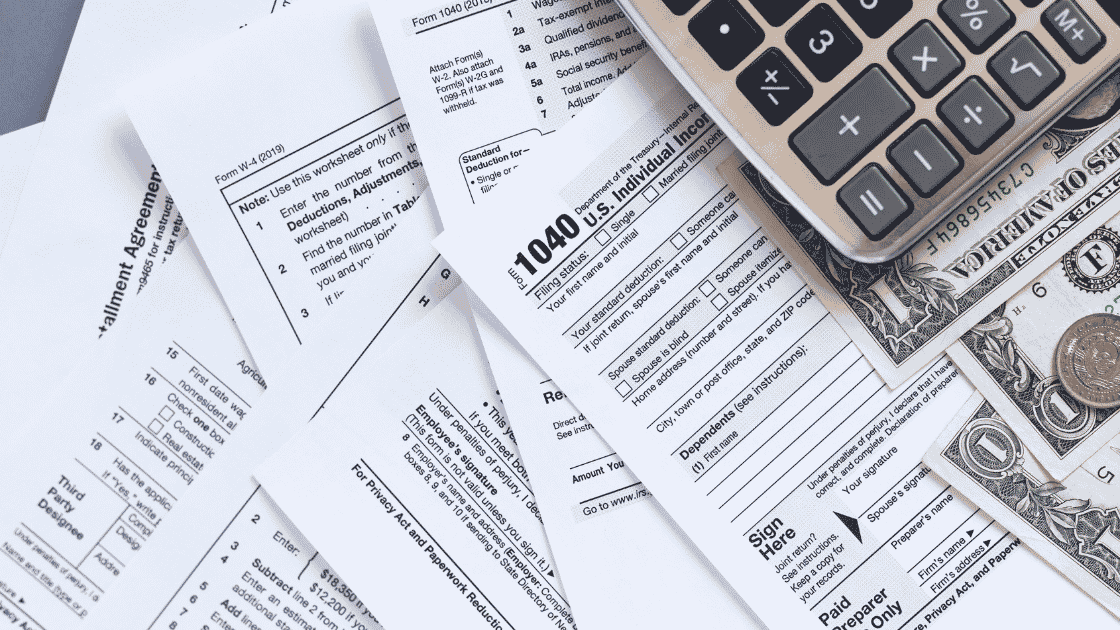
Various financial documents for Form I-864.
Frequently Asked Questions About I-864 Financial Requirements
How can a Sponsor secure financial support options for his/her spouse in Vietnam or the Philippines?
If a sponsor’s qualifying income is not enough, he/she may still be able to meet the requirements by using eligible household income, the spouse’s continuing income, qualifying assets or a joint sponsor, and other available resources.
Can a third-party help meet the Sponsor’s financial requirements?
Yes. A qualifying joint sponsor may help if the Sponsor does not independently meet the income requirements. The joint sponsor generally does not need to be related to the sponsor or spouse but they must meet the requirements on their own and still submit a Form I-864.
What happens if a Sponsor’s income changes after filing a Form I-864?
If a sponsor’s income changes significantly after filing, he/she may need to provide updated financial evidence. For example, a job loss could reduce qualifying income, while a new or higher-paying job may allow the sponsor to submit updated pay records and employment documents before the scheduled interview.
Get Help Meeting the Financial Requirements to Sponsor a Spouse From Vietnam or the Philippines
The Form I-864 can look like a simple financial form but issues involving employment, household size, assets, joint sponsors and U.S. domicile can quickly make the analysis more complicated.
At Enterline and Partners, our U.S. immigration lawyers work with clients in Vietnam, the Philippines and across Southeast Asia on marriage-based immigration matters and other U.S. visa cases. We can review your financial circumstances, identify potential Form I-864 issues and help you determine what evidence may strengthen your case.
If you have questions about sponsoring your Vietnamese or Filipino spouse or are concerned that you may not meet the financial requirements, our team is here to help. Contact our office today to arrange a consultation.
ENTERLINE & PARTNERS CONSULTING
Ho Chi Minh City, Vietnam Office
Level 6 & 7, Friendship Tower, 31 Le Duan Street, Sai Gon Ward
Ho Chi Minh City, Vietnam
Tel: +84 933 301 488
Email: info@enterlinepartners.com
Facebook: Enterline & Partners – Dịch vụ Thị thực và Định cư Hoa Kỳ
YouTube: @EnterlineAndPartnersConsulting
Website: https://enterlinepartners.com
Manila, Philippines Office
LKG Tower 37th Floor
6801 Ayala Avenue
Makati City, Philippines 1226
Tel: +63 917 543 7926
Email: info@enterlinepartners.com
Facebook: Enterline and Partners Philippines
Website: https://enterlinepartners.com/en/home/
Copyright 2026. This article is for information purposes only and does not constitute legal advice. This article may be changed with or without notice. The opinions expressed in this article are those of Enterline and Partners only.