Enterline & Partners Consulting | info@enterlinepartners.com

David Enterline Speaks at EB-5 Seminar in Ho Chi Minh City, Vietnam in April

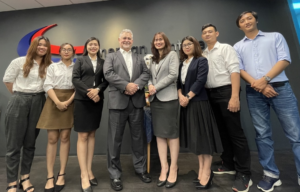
Vietnam is open for business!  “It is great to be back.  Ho Chi Minh City seems back to its normal self; full of energy and excitement and opportunity for Vietnamese” says David Enterline, Esq., of Enterline and Partners Consulting, who returned after almost two years of COVID induced absence to speak at an EB-5 seminar in Ho Chi Minh City on April 27, 2022.
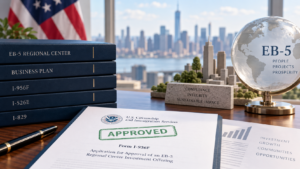
Much of the seminar was dedicated to introducing many of the changes to the EB-5 program as a result of the EB-5 Reform and Integrity Act of 2022 (“Act”), which was pass by Congress and signed by the President on March 15th this year.  The Act sets new minimum investment levels of $1.05 million, or a reduction to $800,000 if the project is located in a qualified targeted employment area.

Some highlights of the Act that are for the benefit of investors include:

  • Investors who have already filed I-526 Petitions under previous law and regulations may continue with their EB-5 processing, and will be protected even if the regional center program were to lapse again;
  • Investors that are already in the United States in valid nonimmigrant visa status can now file their I-526 Petitions concurrently with a Form I-485 Application for Adjustment of Status;
  • New integrity measures will be established that will protect investors by adding oversight to watch over investor’s capital, reporting requirements for regional centers and their operators, and requiring disclosures of all fees paid to all interested parties in the process.

While most of these new provisions of the Act are set to become effective on May 15th, filing I-526 Petitions under the Regional Center Program will not begin immediately.  The Act introduced many new legal requirements which will need to be worked out by the United States Citizenship and Immigration Services through policy implementation and legal regulations.

For more information on the EB-5 immigrant investor visa, contact us at: info@enterlinepartners.com and speak with a U.S. immigration attorney in Ho Chi Minh City, Manila and Taipei.

ENTERLINE & PARTNERS CONSULTING

Ho Chi Minh City, Vietnam Office

Suite 601, 6th Floor, Saigon Tower
29 Le Duan Street
Ben Nghe Ward, District 1
Ho Chi Minh City, Vietnam

Tel: +84 933 301 488

Email: info@enterlinepartners.com

Facebook: Enterline & Partners – Dịch vụ Thị thực và Định cư Hoa Kỳ

Website: http://enterlinepartners.com

Manila, Philippines Office

LKG Tower 37th Floor
6801 Ayala Avenue
Makati City, Philippines 1226

Tel: +632 5310 1491

Email: info@enterlinepartners.com

Facebook: Enterline and Partners Philippines

Website: https://enterlinepartners.com/language/en/welcome/

Copyright 2022. This article is for information purposes only and does not constitute legal advice. This article may be changed with or without notice. The opinions expressed in this article are those of Enterline and Partners only.


CATEGORY
time
recent posts
CTA_Collection

contact us today for more information

Latest News

visa K1, CR-1

K-1 Fiancé(e)’ Visa vs. CR-1 Spousal Visa: Which is the Right Path For Your Vietnamese Fiance(é) Or Spouse?

For many American and Vietnamese couples looking to immigrate to the United States, a major question is whether they should apply for a K-1 fiancé(é) visa or a CR-1 spousal visa. While both lead to lawful permanent residence status (“Green Card”), they work very differently. A K-1 fiancé(e) visa allows a Vietnamese fiance(é) to enter the United States so the couple can marry within ninety (90) days upon the Vietnamese fiance(é)’s arrival. A CR-1 spousal visa allows a Vietnamese spouse to enter the United States with an immigrant visa and be granted CR-1 status if the couple is married for less than two (2) years. The right choice depends on many factors such as your relationship status, wedding plans, timeline, budget, and long-term priorities.  We compare the K-1 fiancé(e) and CR-1 options for American and Vietnamese couples including eligibility, timelines, filing fees, work authorization, international travel, and common situations where

Read more >

Passport Revocation for Child Support Arrears

On May 7, 2026, the United States Department of State (“DOS”) announced that it will begin revoking U.S. passports for certain individuals with outstanding child support arrears. Under existing federal regulations (22 CFR §51.62) and DOS policy guidance (7 FAM 1754), DOS may deny or revoke a U.S. passport when the Department of Health and Human Services (“DHHS”) certifies that an individual owes more than US$2,500 in child support. Although this authority has existed for years, the announcement signals increased enforcement efforts. According to recent reports, the initial phase may focus on individuals with arrears exceeding US$100,000, with broader enforcement potentially expanding to all individuals owing more than US$2,500. Once revoked, a passport may no longer be used for international travel. In most cases, the individual will not become eligible for a new passport until DHHS certifies that the child support arrears have been resolved. If an individual is overseas

Read more >

Protection from Regional Center Program Expiration – Grandfathering before September 30, 2026

The EB-5 Reform and Integrity Act of 2022 (“RIA”) introduced several important changes to the EB-5 Regional Center Program. One of the most important protections for investors is commonly referred to as the “grandfathering” provision found in Section 108 of the RIA, titled “Protection from Expired Legislation.” Since its creation in 1993, the EB-5 Regional Center Program has always been a pilot, or “test”, program.  Historically, it has required periodic reauthorization by the United States Congress. In the past, temporary lapses in authorization created uncertainty for investors with pending I-526E, Immigrant Petition by Regional Center Investor petitions. Many investors were at risk that USCIS would stop processing their cases if the Regional Center Program expired before petition approval or visa issuance. To address these concerns, Congress included additional protections in the RIA intended to help investors continue moving forward with their immigration process even if the Regional Center Program expires

Read more >
Zalo
Phone
WhatsApp
Messenger
Messenger
WhatsApp
Phone
Zalo