Enterline & Partners Consulting | info@enterlinepartners.com

Understanding Form I-864A: Contract Between Household Member and Sponsor

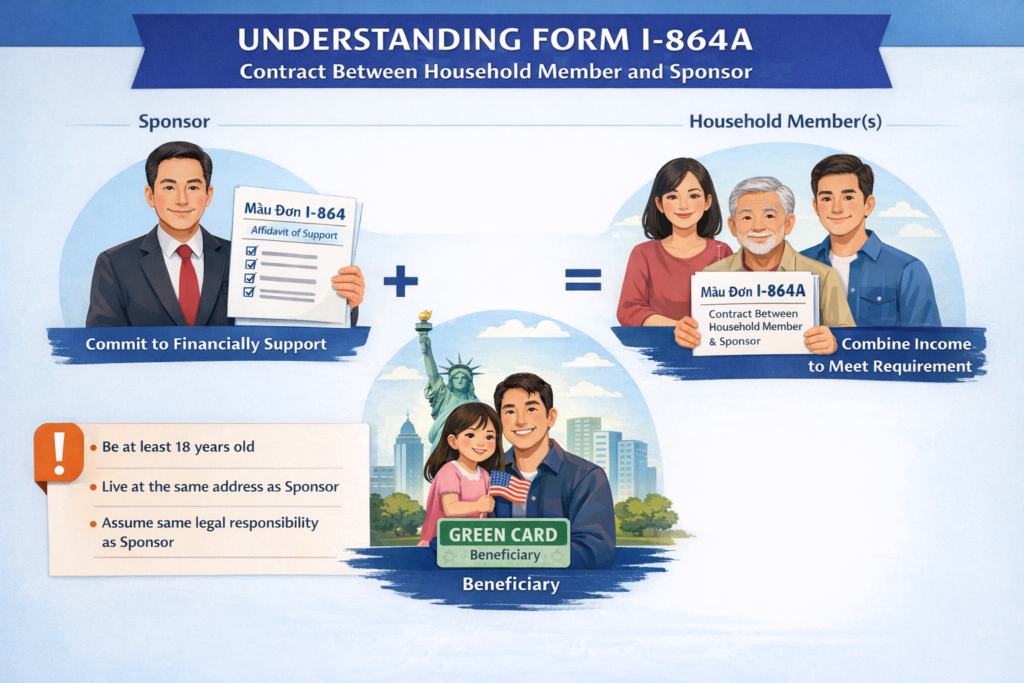
For many family-based immigrants applying for a Green Card, a key step in the process is the submission of Form I-864, Affidavit of Support (“I-864”). This is a legally binding contract in which the sponsoring family member (“Sponsor”) agrees to financially support the intending immigrant (“Beneficiary”). However, in some cases, the “Sponsor” alone may not have sufficient income or assets to meet the required financial support threshold. That is where Form I-864A, Contract Between Sponsor and Household Member (“Form I-864A”) comes into play.

A Form I-864A,  is used when a household member—such as a spouse, adult child, parent, or other relative residing at the same address—agrees to combine their income with the Sponsors to meet the minimum financial requirement. The household member must be willing to commit to support the Beneficiary alongside the Sponsor by signing the Form I-864A.

It is important to understand the difference between the I-864 and Form I-864A. While the I-864 is submitted by the Sponsor, a Form I-864A is submitted by the household member who shares income or assets with the Sponsor. This is different from a joint sponsor, who files a separate I-864 and does not live in the same household.

To qualify as a household member under a Form I-864A, the individual must be at least eighteen (18) years old, reside at the same address as the Sponsor, and be related by birth, marriage, or adoption. Their income must have been listed on the Sponsor’s most recent tax return, or they must provide independent proof of current and ongoing income.

A Form I-864A carries the same legal weight as the I-864. By signing it, the household member assumes the same responsibilities and agrees to support the Beneficiary under U.S. immigration law. This includes the risk of legal enforcement if the Beneficiary receives certain public benefits.

Understanding when and how to use Form I-864A can help avoid delays and ensure that a family’s petition is financially sound.

If you have questions about the Form I-864A, please contact us at info@enterlinepartners.com.

ENTERLINE & PARTNERS CONSULTING

Ho Chi Minh City, Vietnam Office

146C7 Nguyen Van Huong St, An Khanh Ward,
Ho Chi Minh City, Vietnam

Tel: +84 933 301 488
Email: info@enterlinepartners.com
Facebook: Enterline & Partners – Dịch vụ Thị thực và Định cư Hoa Kỳ
YouTube: @EnterlineAndPartnersConsulting
Website: https://enterlinepartners.com

Manila, Philippines Office

LKG Tower 37th Floor  
6801 Ayala Avenue   
Makati City, Philippines 1226   

Tel: +63 917 543 7926
Email: info@enterlinepartners.com
Facebook: Enterline and Partners Philippines
Website: https://enterlinepartners.com/en/home/

Copyright 2025. This article is for information purposes only and does not constitute legal advice. This article may be changed with or without notice. The opinions expressed in this article are those of Enterline and Partners only.


CATEGORY
time
recent posts
CTA_Collection

contact us today for more information

Latest News

New USCIS Policy Aims to Reduce Frivilous and Incomplete Filings

The United States Citizenship and Immigration Services (“USCIS”) has amended a previous policy during the Biden Administration which encouraged adjudicating officers to issue a Request for Evidence (“RFE”) before denying an immigration benefit even if the benefit being sought was filed incomplete, the requestor failed to demonstrate eligibility for the benefit being sought, or did not provide initial evidence clearly required at the time of submission. According to USCIS, the previous policy allowed for frivolous or substantially incomplete filings which slowed processing times and led to increased operational costs. The new policy, which was announced on August 5, 2026, restores an adjudicating officer’s full discretion in denying an immigration benefit without first issuing an RFE or a Notice of Intent to Deny (“NOID”). Updated policy highlights include the following:  The revised policy is effective immediately and applies to immigration benefits that remain pending with USCIS or filed on or after

Read more >

Do You Need a U.S. Immigration Lawyer if You Are in Vietnam? Five Reasons Why You Shouldn’t Do It Alone

Applying for a U.S. visa from Vietnam may seem straightforward when the forms are available online and the basic steps appear clear. However, the process may become difficult when there is a prior visa refusal, past marriage and name issues, missing documents or anything else that may require a closer review. These details can easily affect eligibility, timing and how the case should be prepared before applying. At Enterline and Partners, we help clients in Vietnam understand their U.S. immigration options with guidance from licensed U.S. immigration attorneys who have experience handling cases involving Vietnamese applicants and beneficiaries. In this guide, we explain when working with a U.S. immigration lawyer who has experience assisting clients in Vietnam may be helpful, how legal guidance differs from visa agencies and what to consider before deciding whether you need a lawyer for your case. What Can a U.S. Immigration Lawyer Do For Your

Read more >
sponsor Vietnamese spouse green card

How to Petition Your Vietnamese Spouse for a U.S. Green Card?

Marriage to a U.S. Citizen does not automatically grant a Vietnamese spouse the right to live permanently in the United States. Before a Vietnamese spouse can immigrate to the United States, the U.S. Citizen or Lawful Permanent Resident (“Petitioner”) must first establish the marital relationship, complete the required documentation and have the process go through the U.S. immigration system. Multiple government agencies are involved including United States Citizenship and Immigration Services (“USCIS”), the United States Department of State (“DOS”), National Visa Center (“NVC”) and the U.S. Consulate General in Ho Chi Minh City. Each stage has separate forms, evidence requirements and deadlines. At Enterline and Partners, our U.S. immigration lawyers assist Petitioners with a spouse in Vietnam who would like to bring their Vietnamese spouses to the United States permanently. In this guide, we explain the sponsorship process, the difference between filing as a U.S. Citizen or a Lawful Permanent

Read more >
Zalo
Phone
WhatsApp
Messenger
Messenger
WhatsApp
Phone
Zalo