Increased Investment Amounts Of The RIA
Written by David Enterline, U.S Immigration Attorney | Last reviewed: November 2026
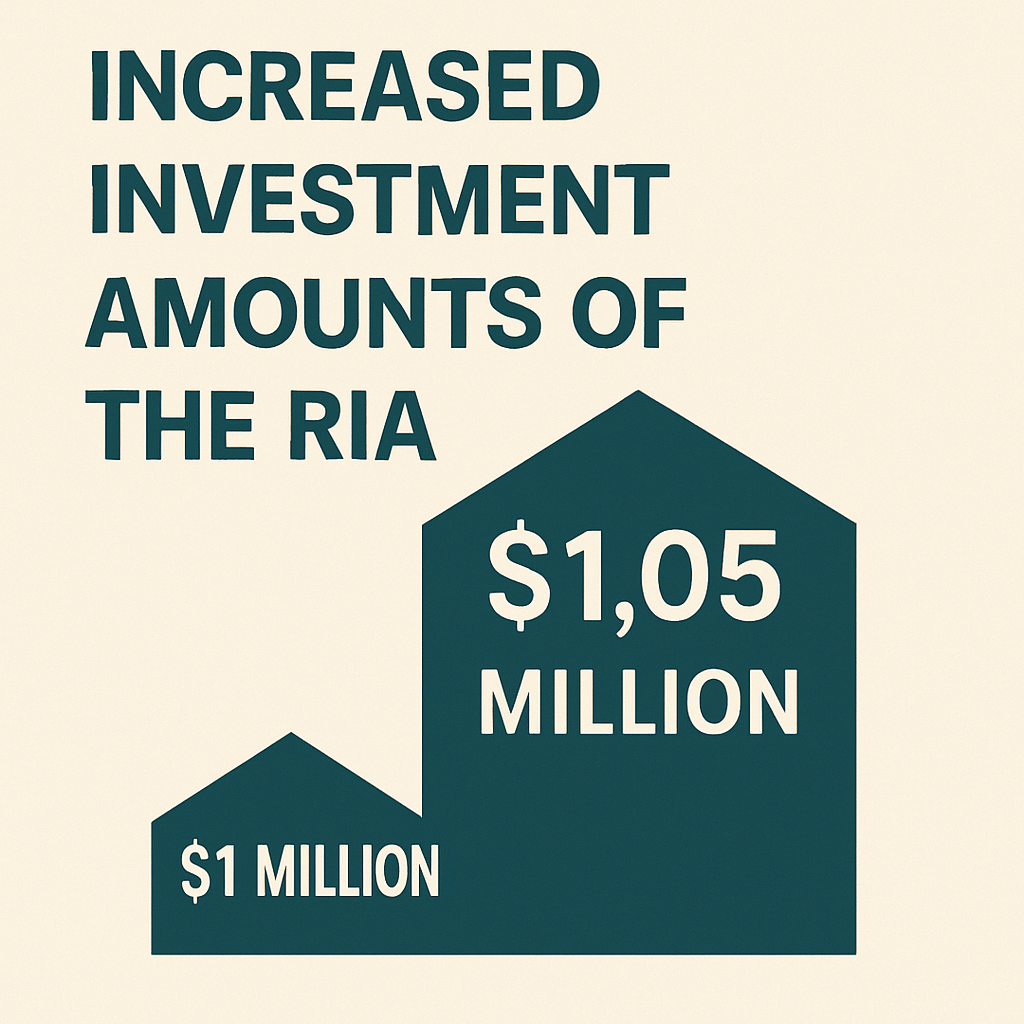
The Increased Investment Amounts section of the EB-5 Reform and Integrity Act of 2022 (“RIA”) raises the minimum investment thresholds to adjust for inflation and ensure the continued effectiveness of the program in promoting economic growth and job creation in the United States.
Under the updated rules, the standard investment amount required for the EB-5 program has increased from $1 million to $1.05 million. For investments in Targeted Employment Areas (TEAs), which include rural areas or those with high unemployment, the minimum investment rises from $500,000 to $800,000. The original investment amounts had not been increased since the EB-5 program was created in 1990.
These changes are intended to maintain the program’s ability to generate substantial capital for U.S. businesses and encourage investment in areas that need economic development. The increase in the minimum investment ensures that the program continues to meet its goal of creating jobs and stimulating growth in underdeveloped regions. By raising the investment levels, the RIA aims to make the program more effective and relevant to today’s economic conditions while continuing to attract foreign investment to the United States.
Frequently Asked Questions About EB-5 Investment Amounts
What is the minimum investment for the EB-5 visa under the RIA?
Under the EB-5 Reform and Integrity Act of 2022, there are two minimum investment levels: $800,000 for projects in a Targeted Employment Area (TEA – including rural areas, high-unemployment areas, and infrastructure projects), and $1,050,000 for projects outside a TEA. Most Vietnamese and Filipino investors choose TEA projects to benefit from the lower threshold and, for rural projects, the 20% annual visa set-aside.
How have EB-5 investment amounts changed since 1990?
The original 1990 investment amounts of $1,000,000 (standard) and $500,000 (TEA) were never adjusted for inflation during nearly 30 years. In 2019, DHS increased them to $1,800,000 and $900,000. The RIA 2022 reset them to $1,050,000 and $800,000 and established a periodic inflation adjustment mechanism – the first time in the program’s history.
Can EB-5 investment amounts increase in the future?
Yes. RIA authorizes USCIS to adjust minimum investment amounts every five years based on inflation indices. This is a significant change from prior law, which had no adjustment mechanism. Investors should confirm current amounts with an EB-5 attorney before committing capital, and should be aware that future adjustments could increase the threshold.
What costs are there beyond the $800,000 minimum investment?
In addition to the $800,000 minimum capital investment, investors typically pay: Regional Center administrative fees (generally $50,000-$75,000); USCIS I-526E filing fee (currently $3,675 effective November 13, 2025 per court order); legal fees for petition preparation; and costs associated with source of funds documentation. Total out-of-pocket costs are typically meaningfully higher than the minimum investment amount alone.
Why is the TEA investment amount ($800,000) lower than the standard amount ($1,050,000)?
The $250,000 differential is a deliberate policy tool used by Congress to direct EB-5 capital toward areas of the United States that have the greatest need for economic development – including rural communities and areas with high unemployment rates. Rural TEA projects receive an additional benefit: a 20% annual visa set-aside priority under RIA. This dual incentive is designed to make rural and high-unemployment projects attractive to foreign investors relative to standard market-rate projects.
If you have question about the EB-5 visa, contact us at info@enterlinepartners.com.
ENTERLINE & PARTNERS CONSULTING
Ho Chi Minh City, Vietnam Office
146C7 Nguyen Van Huong St, Thao Dien Ward,
District 2, Thu Duc City
Ho Chi Minh City, Vietnam
Tel: +84 933 301 488
Email: info@enterlinepartners.com
Facebook: Enterline & Partners – Dịch vụ Thị thực và Định cư Hoa Kỳ
YouTube: @EnterlineAndPartnersConsulting
Website: http://enterlinepartners.com
Manila, Philippines Office
LKG Tower 37th Floor
6801 Ayala Avenue
Makati City, Philippines 1226
Tel: +63 917 543 7926
Email: info@enterlinepartners.com
Facebook: Enterline and Partners Philippines
Website: https://enterlinepartners.com/language/en/welcome/
Copyright 2025. This article is for information purposes only and does not constitute legal advice. This article may be changed with or without notice. The opinions expressed in this article are those of Enterline and Partners only.