Updated for 2025: Heightened Enforcement at Ports of Entry
Like all international travelers, lawful permanent residents (LPRs)—also known as Green Card holders—are subject to inspection by U.S. Customs and Border Patrol (CBP) when arriving at an airport or land port of entry. While LPRs enjoy greater rights than nonimmigrants when returning to the United States after travel abroad, all noncitizens now face increased scrutiny at the border for past immigration issues, interactions with police, and political activity. It is important that you know your rights when returning to the United States.
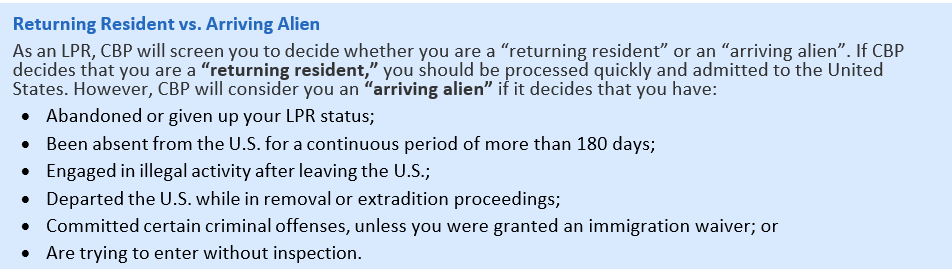
Secondary Inspection:
If questions arise and CBP is unable to admit you quickly, you may be taken to a separate area for “secondary inspection.” Being sent for a secondary inspection by itself does not necessarily mean you are in trouble, but you may be held anywhere from a few minutes to several hours or longer. During secondary inspection, CBP will determine whether you should be allowed to enter the United States. During secondary inspection:
- CBP may ask questions, run checks, and collect your biographic and biometric data (such as fingerprints and photographs).
- Your phone, laptop, or other electronic devices may be searched and kept temporarily. Searches may include screening of your social media activity. In some cases, devices may be held and returned later. Please see our Electronic Device Search Flyer for more information.
- You may request a receipt for your devices if taken by CBP.
- You may be detained if CBP has concerns about your admissibility.
Warning About Form I-407: Abandonment of LPR Status
CBP may ask you to sign Form I-407, Record of Abandonment of Lawful Permanent Resident Status. DO NOT sign this form unless you have spoken to a lawyer. Form I-407 must be signed voluntarily. It is important to know that:
- You cannot lose your LPR status because of time spent outside the U.S. without being allowed to have an immigration judge review a presumption of abandonment.
- The government must prove abandonment of LPR status by clear, unequivocal, and convincing evidence in removal court proceedings. CBP cannot do this at the border.
- If you refuse to sign Form I-407, CBP must issue you a Notice to Appear for immigration court.
- If CBP takes your green card, you may request evidence of your status by stamping your passport. If they refuse, you may schedule a USCIS appointment to request an I-551 stamp in your passport as proof of your status.
If You Are Detained – Know Your Rights:
If CBP believes you are inadmissible or you refuse to sign a Form I-407, you may be detained overnight or transferred to immigration detention. You still have the following rights:
- You have the right to contact your consulate. The consulate can help you contact a lawyer or family member.
- You may ask to speak with a lawyer. CBP may deny access to a lawyer, but it is worth asking for the record.
- You have the right to remain silent and not sign any documents without legal advice, especially if you notice errors in the documents or do not agree with their content.You have the right to review all written statements that are prepared for you, in a language that you can understand.
- You have the right to ask for an interpreter if you do not fully understand the questions being asked or the documents you are given. Do not sign anything you do not understand.
Right to an Immigration Judge
If CBP claims that you are removable, you have the right to a hearing before an immigration judge. Do not waive this right. An immigration judge—not CBP—must decide if your green card status can be taken away.
Questions About Politics, Religion, or Activism
CBP may ask about your political beliefs, associations, or participation in protests. You do not have to answer questions about protected First Amendment activity. You may decline to respond to inappropriate questions.
Before You Travel
Consult an immigration lawyer before traveling if:
- You have a criminal record—even for minor offenses/arrests—or a pending criminal case.
- You have pending applications with USCIS or immigration court.
- You have past immigration violations or challenging interactions with CBP.
- You are a conditional resident.
Important Reminders
- Travel with the contact information for your lawyer and your consulate on a separate paper.
- Let your family know your travel plans and check in when you land.
- If detained, try to contact a lawyer or have someone advocate for you. In some instances, having a Form G-28 signed by your immigration lawyer in hand can be helpful.
For additional legal support and a review of your case, consult an immigration lawyer. If you do not have an immigration lawyer, you can find a licensed one at www.ailalawyer.com.
This flyer is intended for general information purposes only and does not constitute legal advice. You should not act or rely on any information in this flyer without seeking the advice of a competent, licensed immigration attorney.

ENTERLINE AND PARTNERS CONSULTING
Ho Chi Minh City, Vietnam Office
Level 6 & 7, Friendship Tower, 31 Le Duan Street, Sai Gon Ward
Ho Chi Minh City, Vietnam
Tel: +84 933 301 488
Email: info@enterlinepartners.com
Facebook: Enterline & Partners – Dịch vụ Thị thực và Định cư Hoa Kỳ
YouTube: @EnterlineAndPartnersConsulting
Website: https://enterlinepartners.com
Manila, Philippines Office
LKG Tower 37th Floor
6801 Ayala Avenue
Makati City, Philippines 1226
Tel: +63 917 543 7926
Email: info@enterlinepartners.com
Facebook: Enterline and Partners Philippines
Website: https://enterlinepartners.com/en/home/
Copyright 2026. This article is for information purposes only and does not constitute legal advice. This article may be changed with or without notice. The opinions expressed in this article are those of Enterline and Partners only.