A Form I-130, Petition for Alien Relatives, is filed with the U.S. Citizenship and Immigration Services (“USCIS”) to establish a qualifying family relationship between a U.S. citizen or lawful permanent resident (Green Card Holder) and a foreign national immediate relative (“Beneficiary”) .
Submitting the Form I-130 is the first step in helping your eligible Beneficiary relative obtain an immigrant visa to enter the United States.
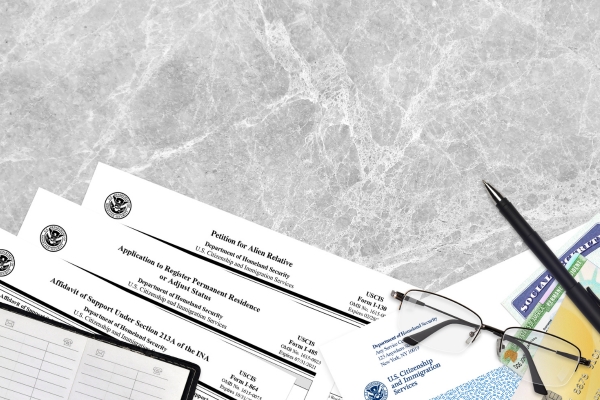
What is a Form I-130?
Form I-130 is used by U.S. citizens or Green Card Holders to sponsor immediate family members for lawful permanent residence (Green Card) in the United States.
This form helps USCIS verify that a valid family relationship exists, and it starts the immigration process for the Beneficiary.
20+ Frequently Asked Questions About the Form I-130
1. Who Can File a Form I-130?
U.S. citizens aged 21 or older may file for:
- Spouse;
- Children (of any age, including married children);
- Parent(s);
- Sibling(s).
Lawful permanent residents (Green Card Holders) may file for:
- Spouse;
- Unmarried children (any age).
2. What Are the Requirements for the Beneficiary?
- Must have a legal familial relationship with the U.S. citizen or Green Card Holder;
- Must not be barred from entering the U.S. (e.g., due to immigration violations or certain criminal issues);
- Will undergo background checks, medical exams, and financial screening -> Background checks, medical exams, and financial screening occur only after the I-130 petition is approved. The I-130 itself focuses solely on the U.S. citizen or Green Card holder, not the intended immigrant.
3. Does Filing a Form I-130 Grant a Visa Right Away?
No. Filing the Form I-130 only establishes the relationship. Once approved, the Beneficiary must wait for an available visa in their category before applying for an immigrant visa .
4. What’s the Difference Between IR and Family-Preference Categories?
- IR (Immediate Relative): No annual limits on visas. Includes spouses, unmarried children under 21, and parents of U.S. citizens.
- Family Preference: Subject to yearly visa limits. Includes siblings, adult children, and other extended relatives.
5. Where Can You Submit a Form I-130?
- Online: Through the USCIS website, if eligible
- By mail: To a USCIS lockbox in Texas, Arizona, or Illinois, depending on the U.S. citizen or Green Card Holders location and method of delivery
- At a U.S. Embassy or Consulate under discretionary exceptional circumstances.
- Download the I-130 Form (PDF): https://www.uscis.gov/i-130
6. How Much Does It Cost to File a Form I-130?
- Official filing fee: US$625 for online filing or US$675 for paper-based filing.
- The fee is non-refundable.
7. What Documents Are Required for the Form I-130 Petition?

To file a Form I-130, you will need to prepare:
- A completed and signed Form I-130 Petition
- A copy of the petitioner’s proof of identity (e.g., U.S. passport, green card)
- Evidence of the family relationship (e.g., birth certificates, marriage certificate, photographs, letters, joint financial records)
- Two passport-style photos (2×2 inches or 5×5 cm)
8. How Long Is the Form I-130 Processing Time?
Processing times may vary based on the USCIS service center and visa backlog in the preference category although eighty (80) percent of all cases are adjudicated within seventeen (17) months. However, this is frequently subject to change.
9. Can I File a Form I-130 and Form I-485 at the Same Time?
Yes, concurrent filing is allowed if the beneficiary is already in the U.S. and qualifies for Adjustment of Status by filing a Form I-485, Application to Register Permanent Residence or Adjust Status.
10. Can I File a Form I-130 Without an Immigration Attorney?
While it is certainly permissible to file a Form I-130 on your own or pro se, if you are unfamiliar with the legal process, consulting an experienced immigration attorney is strongly recommended to avoid delays or denials due to incomplete or incorrect documentation.
11. How Many Relatives Can I Sponsor with a Form I-130?
There is no limit to the number of relatives a U.S. citizen or Green Card Holder can sponsor, as long as each petition meets eligibility requirements.
12. Does a Form I-130 Expire?
Generally, once approved, a Form I-130 does not expire. However, the approved petition is transferred to the National Visa Center (“NVC”) and if there is no further action for a significant period of time, the NVC may terminate the approved Form I-130. Once terminated, a new Form I-130 would need to be filed.
13. Can I Appeal If My Form I-130 Petition Is Denied?
Yes. You may file Form I-290B, Notice of Appeal or Motion up to 33 days after receiving the denial notice allowing you to review or reopen the decision.
14. Do I Need to Submit Financial Documents When Filing Form I-130?
No, financial evidence is not required at the Form I-130 stage. It will be submitted at the NVC stage in conjunction with Form I-864, Affidavit of Support.
15. Can I Track the Status of My Form I-130 Petition?
Yes. After submission, you will receive a USCIS Receipt Number which you can be uses to check your case status online at : https://egov.uscis.gov/casestatus/landing.do
16. Is an Interview Required for a Form I-130?
Only under rare circumstances will USCIS schedule an interview at the Form I-130 stage. However, the beneficiary will be interviewed later during the immigrant visa process at a U.S. Embassy or Consulate (if abroad) or when applying for Adjustment of Status if already in the U.S.
17. Can I Cancel My I-130 Petition After Submission?
Yes. You may send a written request to USCIS to withdraw your petition as long as it hasn’t been approved.
18. Do I Need a Separate I-130 for Each Beneficiary?
Yes. You must file a separate Form I-130 for each Beneficiary, even for spouses and children within the same family. Each beneficiary requires their own petition.
19. What Should the Beneficiary Do After the Form I-130 Is Approved?
Once approved by USCIS, the NVC receives the case. The U.S. citizen or Green Card Holder in coordination with the Beneficiary will prepare supporting documents, complete the DS-260 online visa application form, undergo a medical evaluation and attend an interview at the U.S. Embassy or Consulate.
20. Can Same-Sex Couples File Form I-130?
Absolutely. The USCIS treats same-sex marriages the same heterosexual marriages as long as the marriage is legally valid in the place where it was performed.
21. What Happens If the Petitioner Dies?
In some cases, USCIS may allow the Form I-130 Petition to continue under a “Humanitarian Reinstatement” if the beneficiary has strong ties to the U.S. or another qualifying relative sponsors them.
22. Can I Expedite a Form I-130?
It’s rare, but in limited circumstances (e.g., military deployment, medical emergencies), you can request expedited processing. U.S. citizens residing abroad with an immediate need to relocate back to the United States may also expedite a Form I-130 Petition by filing directly through an Embassy or Consulate under exceptional circumstances.
For more information on filing a Form I-130, contact us today at info@enterlinepartners.com and speak with a U.S. immigration attorney based in Ho Chi Minh City, Manila and Taipei.
ENTERLINE & PARTNERS CONSULTING
Ho Chi Minh City, Vietnam Office
Suite 601, 6th Floor
Saigon Tower
29 Le Duan Street
Ben Nghe Ward, District 1
Ho Chi Minh City, Vietnam
Tel: +84 933 301 488
Email: info@enterlinepartners.com
Website: https://enterlinepartners.com/
Manila, Philippines Office
Unit 2507 Cityland 10 Tower 1
156 H.V. Dela Costa Street
Makati City, Philippines 1209
Tel: +632 5310 1491
Email: info@enterlinepartners.com
Copyright 2021. This article is for information purposes only and does not constitute legal advice. This article may be changed with or without notice. The opinions expressed in this article are those of Enterline and Partners only.
Updated: September 2025