Enterline & Partners Consulting | info@enterlinepartners.com

News & Resources

Trump Gold Card Program Legal: Does It Really Exist; Issues and Uncertainties

On December 10, 2025, United States Citizenship and Immigration Services (“USCIS”) released a Form I-140G, Immigrant Petition for the Gold Card Program (“Form I-140G”) and instructions for the new U.S. “Gold Card” immigration program. The program was (presumably) created by Executive Order of President Trump on September 19, 2025.  The

Affiliated Job-Creating Entity From The RIA

The term “affiliated job-creating entity” is an important term of the EB-5 Reform and Integrity Act of 2022 (“RIA”). Under the EB-5 Immigrant Investor Program, foreign investors who participate make an investment in a new business that employs U.S. workers and can obtain lawful permanent residence in the United States.

US Investment visa
A Complete Guide to the U.S. Investment Visa Process

For individuals looking to build a future in the United States, investment immigration is a viable option for some.   Through a U.S. investment visa, foreign nationals can pursue lawful permanent residence (“Green Card”) by investing capital into U.S. businesses that creates jobs and contributes to the growth of the American

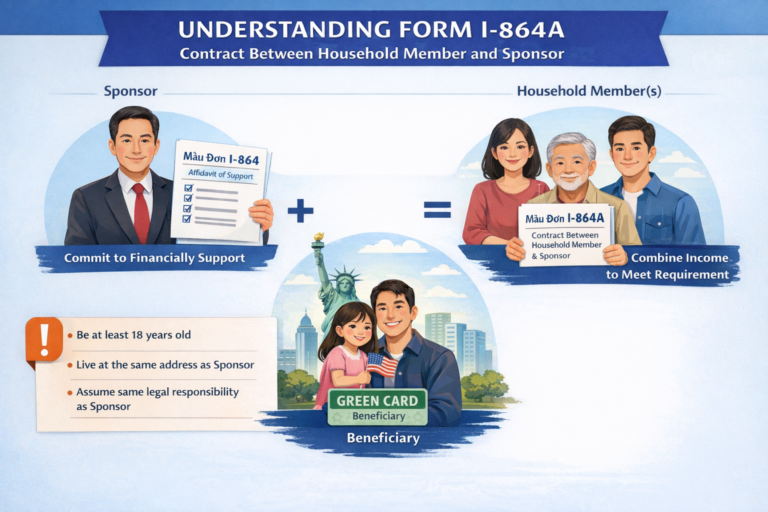
Understanding Form I-864A: Contract Between Household Member and Sponsor

For many family-based immigrants applying for a Green Card, a key step in the process is the submission of Form I-864, Affidavit of Support (“I-864”). This is a legally binding contract in which the sponsoring family member (“Sponsor”) agrees to financially support the intending immigrant (“Beneficiary”). However, in some cases,

K-1 Fiancé(e) Visas
Are K-1 Fiancé(e) Visas Affected by Trump’s 2025 Immigration Policies?

With the return of the Trump administration in 2025, many couples are asking the critical question: “Are K-1 Fiancé(e) visas (hereinafter “fianc(é)”)   affected by Trump’s new immigration policies?” While there is currently no outright ban on K-1 fianc(é) visas, applicants should be prepared for significant changes in processing, increased

Vietnamese Passport Name Order: Common Issues with U.S. Immigration Documents

Many Vietnamese citizens face challenges when their names are listed incorrectly on U.S. immigration documents such as visas and Green Cards. This often happens because the naming style also known as the Vietnamese passport name order follows the format: Given/ Surname name → Middle name → Given name, which differs

What Is Capital In The RIA?

In the EB-5 Reform and Integrity Act of 2022 (“RIA”), the definition of “Capital” as an investment for EB-5 has been updated.  Capital includes cash, as well as any real, personal, or mixed tangible assets that are owned and controlled by the investor and which are invested in, or contributed

David Enterline speaks at IIUSA EB-5 Event in East Asia

Enterline and Partners Managing Partner David Enterline served as Panel Moderator for the IIUSA 2025 Passport Series: East Asia event held in October this year.  He moderated the panel “How to Evaluate and Select the Right EB-5 Project for Investors”. IIUSA is the national membership-based EB-5 industry association for EB-5

What is a Form I-129F? Petition for Alien Fiancé Explained

A Form I-129F is a Petition for Alien Fiancé(e) filed through the United States Citizenship and Immigration Services (“USCIS”). The form can only be filed by a U.S. citizen ages twenty-one (21) and above. Non-US citizens including lawful permanent residents are not able to petition a foreign fiancé(e). Form I-129F

What Is An Alien Registration Number And What Is It For?

The U.S. Alien Registration Number, commonly abbreviated as an A-Number, is a unique identifier assigned to non-citizens by the United States Citizenship and Immigration Services (“USCIS”). This A-Number begins with the letter “A” followed by 8 or 9 numbers (such as A012345678).  It is used to track individuals throughout their

What Does A 214(b) Refusal Mean in U.S. Immigration Law?

A 214(b) refusal in U.S. immigration law refers to a specific section of the Immigration and Nationality Act (“INA”) that is often cited when a U.S. consular officer denies a nonimmigrant visa application. This section is often seen with individuals applying for B-1/ B-2 Visitor Visas but it is applicable

CATEGORY
recent posts
CTA_Collection
Zalo
Phone
WhatsApp
Messenger
Messenger
WhatsApp
Phone
Zalo