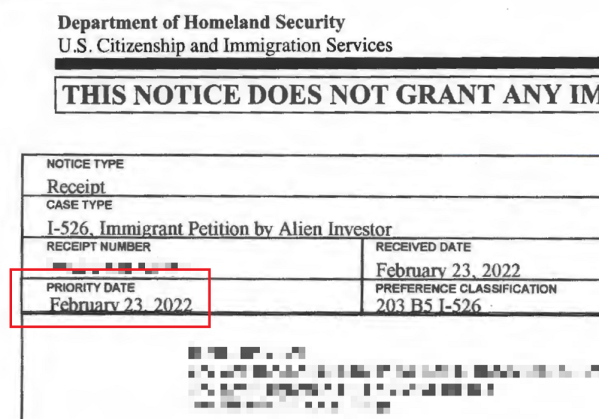
The priority date in U.S. immigration is a critical concept for anyone waiting for lawful permanent residency status (“Green Card”). Because Congress sets strict annual limits on the number of immigrant visas issued in most categories, demand often outstrips supply, creating significant backlogs. Your priority date effectively acts as your “place in line” in this complex government queue.
This priority date is established when the United States Citizenship and Immigration Services (“USCIS”) receives your initial petition, either the Form I-130 (for family-sponsored cases) or the Form I-140 or Labor Certification (for employment-based cases) or Form I-526/I-526E (for investor cases). Think of it as the timestamp on your ticket; until your number is called based on this date, you cannot move forward to the final stage of the immigration process.
Understanding how the USCIS priority date works is vital for managing your expectations, planning your life during the wait, and knowing approximately when you are eligible to take the final steps toward immigrating to the United States.
3 Key Action Steps for Visa Applicants
Consistent monitoring of your status is important. Follow these three steps:
- Know Your Position Accurately: You must identify your specific Priority Date and Preference Category (e.g., F2A for spouses of permanent residents, EB-2 for advanced degree professionals, or EB-5 for investors). You need to be able to track your status because misidentifying your category can lead to prolonged periods of false hope or missed deadlines.
- Monitor the Monthly Visa Bulletin: The U.S. Department of State publishes a Visa Bulletin every month listing “cut-off dates.” Your priority date must be earlier than the listed cut-off date for your category and country of birth to move forward.
- Plan for Wait Times and Life Changes: Visa Bulletin movement can be slow or erratic due to annual quotas, high demand from oversubscribed countries like India, China, Mexico, and the Philippines, and overused or underused visas as anticipated. Prepare for a potential wait of months or even years, and ensure you maintain valid non-immigrant status if you are already in the U.S. during this time.
The Difference Between “Dates for Filing” and “Final Action Dates”
A major source of confusion regarding the priority date is the presence of two charts in the monthly Visa Bulletin. They serve distinct purposes and understanding the difference can offer significant advantages:
- Dates for Filing (Chart B): This date determines when you are eligible to submit your final visa application paperwork.
- Why this Matters: Filing early under Chart B often allows applicants to begin moving forward with the visa application process, such as preparing and providing paperwork, so that you are ready when the visa becomes available.
- Final Action Dates (Chart A): This date determines when a visa number is actually available for issuance. Your case can only be fully adjudicated, which will lead to your Green Card being issued, when your priority date is “current” on this chart.
Crucial Note: The USCIS separately announces monthly which of these two charts applicants living in the U.S. must use. Always check the USCIS website to confirm if Chart B is “open” for your category this month.
For an explanation of the Final Action Date and the Dates for Filing, you can read here.
Why You Must Monitor Visa Retrogression
With significant backlogs in many family and employment categories, visa Retrogression is a constant risk. Retrogression occurs when the cut-off priority date moves backward in time instead of forward due to an unexpectedly high demand for visa numbers in a specific month.
When Retrogression happens, even applications that have already been filed might be held in abeyance until the priority date becomes current again. To help avoid delay, if your priority date is approaching the current cut-off, ensure your documents are ready to file immediately.
Frequently Asked Questions (FAQ) About Priority Dates
How do I find my priority date for U.S. immigration?
Your priority date is listed clearly on the Notice of Action (Form I-797) that you received when your initial I-130, I-140 or I-526/I-526E petition was filed.
What does it mean if my date is “Current” (C)?
If the Visa Bulletin shows a “C” instead of a specific date for your category and country, it means there is currently no backlog. You may proceed with your final application steps immediately without waiting for a visa number to become available.
Why did my cut-off date move backward?
This is called “Retrogression.” It happens when USCIS and the Department of State realize they have received more applications than the remaining annual quota allows for. They must push the date back to pause new final approvals and stay within legal visa limits.
Need Help Navigating the Visa Bulletin?
United States immigration timelines are notoriously complex and can change monthly without warning. If you need guidance on interpreting the monthly Visa Bulletin, determining your filing eligibility based on current charts, or handling unexpected retrogression, we are here to help you turn confusing dates into actionable next steps.
For more information, please contact us at info@enterlinepartners.com and speak with a U.S. immigration attorney in Ho Chi Minh City, Manila and Taipei.
ENTERLINE & PARTNERS CONSULTING
Ho Chi Minh City, Vietnam Office
146C7 Nguyen Van Huong St, An Khanh Ward,
Ho Chi Minh City, Vietnam
Tel: +84 933 301 488
Email: info@enterlinepartners.com
Facebook: Enterline & Partners – Dịch vụ Thị thực và Định cư Hoa Kỳ
YouTube: @EnterlineAndPartnersConsulting
Website: https://enterlinepartners.com
Manila, Philippines Office
LKG Tower 37th Floor
6801 Ayala Avenue
Makati City, Philippines 1226
Tel: +63 917 543 7926
Email: info@enterlinepartners.com
Facebook: Enterline and Partners Philippines
Website: https://enterlinepartners.com/en/home/
Copyright 2025. This article is for information purposes only and does not constitute legal advice. This article may be changed with or without notice. The opinions expressed in this article are those of Enterline and Partners only.