Enterline & Partners Consulting | info@enterlinepartners.com

Understanding Form I-864A: Contract Between Household Member and Sponsor

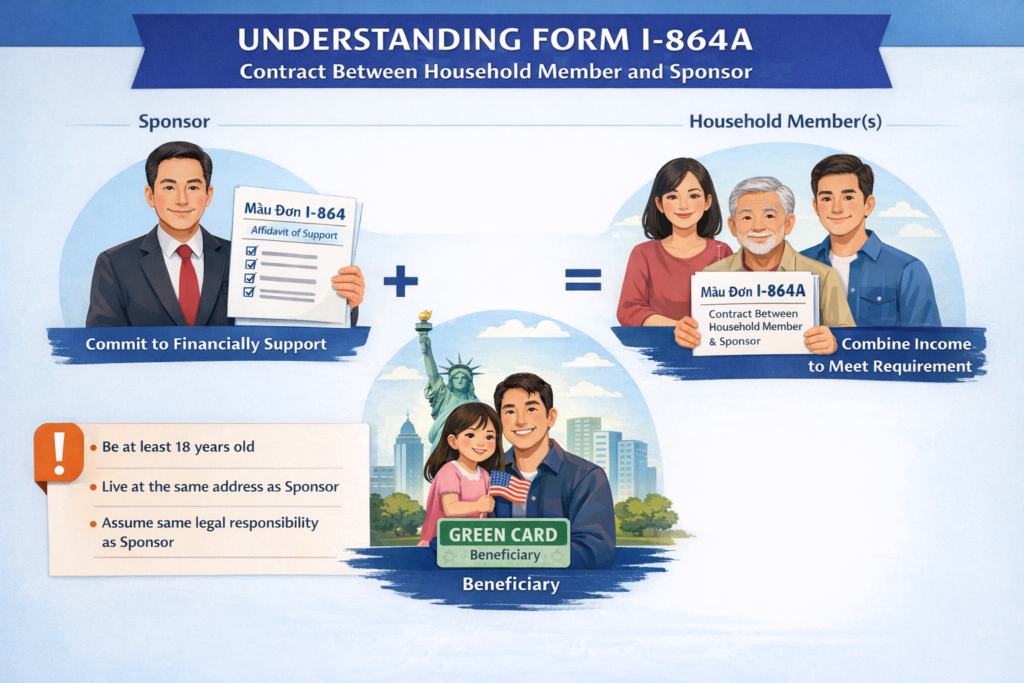
For many family-based immigrants applying for a Green Card, a key step in the process is the submission of Form I-864, Affidavit of Support (“I-864”). This is a legally binding contract in which the sponsoring family member (“Sponsor”) agrees to financially support the intending immigrant (“Beneficiary”). However, in some cases, the “Sponsor” alone may not have sufficient income or assets to meet the required financial support threshold. That is where Form I-864A, Contract Between Sponsor and Household Member (“Form I-864A”) comes into play.

A Form I-864A,  is used when a household member—such as a spouse, adult child, parent, or other relative residing at the same address—agrees to combine their income with the Sponsors to meet the minimum financial requirement. The household member must be willing to commit to support the Beneficiary alongside the Sponsor by signing the Form I-864A.

It is important to understand the difference between the I-864 and Form I-864A. While the I-864 is submitted by the Sponsor, a Form I-864A is submitted by the household member who shares income or assets with the Sponsor. This is different from a joint sponsor, who files a separate I-864 and does not live in the same household.

To qualify as a household member under a Form I-864A, the individual must be at least eighteen (18) years old, reside at the same address as the Sponsor, and be related by birth, marriage, or adoption. Their income must have been listed on the Sponsor’s most recent tax return, or they must provide independent proof of current and ongoing income.

A Form I-864A carries the same legal weight as the I-864. By signing it, the household member assumes the same responsibilities and agrees to support the Beneficiary under U.S. immigration law. This includes the risk of legal enforcement if the Beneficiary receives certain public benefits.

Understanding when and how to use Form I-864A can help avoid delays and ensure that a family’s petition is financially sound.

If you have questions about the Form I-864A, please contact us at info@enterlinepartners.com.

ENTERLINE & PARTNERS CONSULTING

Ho Chi Minh City, Vietnam Office

146C7 Nguyen Van Huong St, An Khanh Ward,
Ho Chi Minh City, Vietnam

Tel: +84 933 301 488
Email: info@enterlinepartners.com
Facebook: Enterline & Partners – Dịch vụ Thị thực và Định cư Hoa Kỳ
YouTube: @EnterlineAndPartnersConsulting
Website: https://enterlinepartners.com

Manila, Philippines Office

LKG Tower 37th Floor  
6801 Ayala Avenue   
Makati City, Philippines 1226   

Tel: +63 917 543 7926
Email: info@enterlinepartners.com
Facebook: Enterline and Partners Philippines
Website: https://enterlinepartners.com/en/home/

Copyright 2025. This article is for information purposes only and does not constitute legal advice. This article may be changed with or without notice. The opinions expressed in this article are those of Enterline and Partners only.


CATEGORY
time
recent posts
CTA_Collection

contact us today for more information

Latest News

David Enterline receives I-829 Petition award for 2025 from IIUSA

David Enterline, Managing Partner of Enterline and Partners Consulting was recognized by IIUSA, the preeminent EB-5 trade association in the United States, for successfully assisting EB-5 immigrant investor clients in obtaining approvals of Form I-829, Petition by Investor to Remove Conditions on Permanent Resident Status during the year 2025. David was recognized together with a select group of experienced EB-5 attorneys and Regional Centers that have demonstrated a strong record of successful outcomes for EB-5 investors. The recognition was presented during the 2026 IIUSA EB-5 Industry Forum held in Washington, District of Columbia. IIUSA (Invest in the USA) is the national membership-based trade association representing stakeholders in the EB-5 Regional Center Program. Its members are responsible for a significant portion of the investment capital and job creation generated across the United States through the EB-5 Program. IIUSA recognizes EB-5 attorneys and Regional Centers whose investors have successfully received I-829 Petition

Read more >

What is a K-3 Visa and How is it Different from a CR-1/ IR-1 Visa?

When researching U.S. family visa application options to the U.S., some couples may inquire on what the K-3 visa is and whether it is the fastest U.S. visa for family members based on marriage. Defining the K-3 Visa A K-3 visa is a non-immigrant visa issued to a foreign spouse married to a U.S. citizen. Like a K-1 visa, a K-3 visa is also filed using a Form I-129F Petition for Alien Fiancé(e) (“Form I-129F”).  It is intended to shorten the separation period between the married couple allowing the foreign spouse to enter the United States while awaiting approval of his or her Form I-129F and subsequent immigrant visa. Differences Between K-3 and CR-1/IR-1 Visas Unlike a CR-1/IR-1 U.S. visa in which the foreign spouse would arrive in the United States as an immigrant and be granted lawful permanent resident status (“Green Card”) upon arrival, a K-3 visa requires the

Read more >

Priority Processing for Investments Made In Rural Areas

The EB-5 Reform and Integrity Act of 2022 (“RIA”) establishes priority processing for rural areas, ensuring that Form I-526/I-526E Petitions (“Petitions”) filed for business or projects in these areas are expedited. Under this provision, Petitions for EB-5 investments in rural areas shall be prioritized in processing and adjudication, allowing investors and project developers in these areas to benefit from faster review times and reduced delays. Any Rural or High-unemployment area identified by the Secretary of Homeland Security is considered a Targeted Employment Area (“TEA”). Rural areas are those located outside the geographic boundaries of a metropolitan statistical area and outside cities or towns with a population of 20,000 or more, based on the most recent decennial census. This classification is to encourage EB-5 investments into target areas that are genuinely rural and in need of economic stimulation. Priority processing for rural areas supports the EB-5 program’s broader goal of stimulating

Read more >
Zalo
Phone
WhatsApp
Messenger
Messenger
WhatsApp
Phone
Zalo