The United States Supreme Court has formally struck down President Donald Trump’s Executive Order (“EO”) 14160 restricting birthright citizenship.
By a 6-3 vote, the Court held that the long-settled understanding of the 14th Amendment, which was adopted after the American Civil War, holds that anyone born on American soil is a natural U.S. citizen with very few exceptions.
The Supreme Court’s decision comes after a series of setbacks from federal judges at the district and circuit court levels that began immediately after President Trump signed the EO hours after he was sworn in as the 47th President.
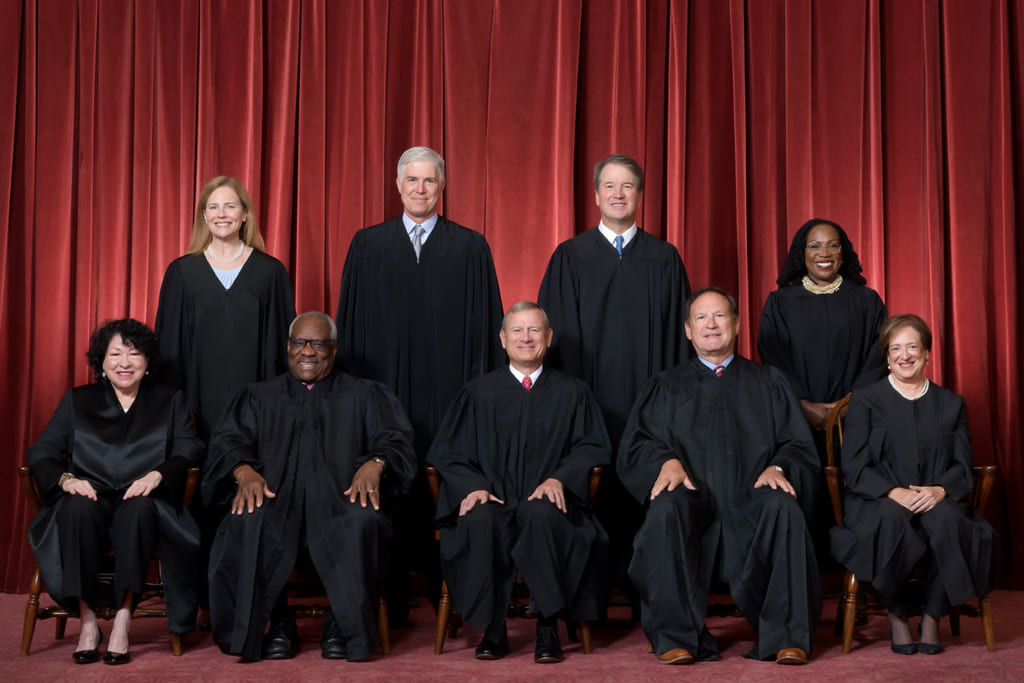
Writing for the majority, Chief Justice John Roberts commented “[C]itizenship, then and now, was the right to have rights—to freely participate in our political community. The Framers of the Fourteenth Amendment extended that promise to ‘every free-born person in this land. We keep that promise today.”
Chief Justice Roberts, known as a conservative justice, was joined by the three liberal Justices Sonia Sotomayor, Elena Kagan, and Ketanji Brown Jackson. Justice Amy Coney-Barrett, a conservative who was appointed at the end of the first Trump administration also voted with the majority.
While disagreeing with the constitutionality of the ruling but ultimately siding with the majority based on federal law, Justice Brett Kavanaugh wrote a separate opinion stating that Congress could, consistent with the 14th Amendment, enact new legislation which would establish more exceptions for birthright citizenship but Congress has not done so yet.
Conservative Justices Samuel Alito, Neil Gorsuch, and Clarence Thomas dissented, arguing that the 14th Amendment does not automatically grant citizenship to children born within the United States. In his dissenting opinion, Justice Thomas, who was appointed to the Supreme Court in 1991 by President George H.W. Bush wrote that the Court ignored evidence of debates during the Reconstruction Era which followed the American Civil War and suggested that citizenship depended on a deeper relationship to the country.
“The Citizenship Clause was enacted for people who were born in this country and called it home. It was enacted for freed slaves such as Dred Scott, who had ‘a domicile’ here and therefore were entitled to sue as citizens,” wrote Thomas.
“In my view, the Citizenship Order is not facially unconstitutional,” Thomas wrote, referring to Trump’s Executive Order. “The Order is consistent with the original meaning of the Citizenship Clause, at least insofar as it applies to children born to parents, here lawfully or unlawfully, who are not domiciled in the United States.”
Frequently Asked Questions About the Supreme Court Birthright Citizenship Ruling
What did the U.S. Supreme Court rule on birthright citizenship on July 3, 2026?
By a vote of 6-3, the U.S. Supreme Court struck down President Trump’s Executive Order No. 14160, ruling it unconstitutional. The decision affirms that under the Fourteenth Amendment to the U.S. Constitution, anyone born on U.S. soil is a U.S. citizen – a right that cannot be restricted by presidential executive order.
What did Trump’s Executive Order 14160 attempt to do and why was it struck down?
Executive Order 14160 sought to restrict birthright citizenship by denying U.S. citizenship to children born in the United States whose parents were not U.S. citizens or lawful permanent residents. The Supreme Court struck it down because it contradicted the Fourteenth Amendment, long interpreted to automatically confer citizenship on virtually anyone born on U.S. soil.
Which justices voted to uphold and which dissented?
6 justices voted to STRIKE DOWN the order (ruling it unconstitutional): Chief Justice John Roberts, Sonia Sotomayor, Elena Kagan, Ketanji Brown Jackson, Amy Coney Barrett, and Brett Kavanaugh. 3 justices DISSENTED: Samuel Alito, Neil Gorsuch, and Clarence Thomas – arguing the Fourteenth Amendment does not automatically grant citizenship to all children born on U.S. soil.
Does this ruling affect children of Vietnamese and Filipino nationals born in the United States?
Yes – in a positive direction. The ruling confirms that children born in the United States – including children of Vietnamese and Filipino nationals – remain recognized as U.S. citizens under the Fourteenth Amendment. Executive Order 14160 has been fully struck down and has no legal effect.
Can Congress change birthright citizenship in the future?
Justice Kavanaugh’s separate concurrence suggests that Congress – through legislation, not presidential executive order – could potentially enact laws adjusting birthright citizenship in a manner consistent with the Fourteenth Amendment. However, Congress has not done this to date, and any such change would require a lengthy and complex legislative process. The current ruling fully protects birthright citizenship as it has been understood for over 150 years.
For more information on the Supreme Court’s ruling, contact us at info@enterlinepartners.com.
ENTERLINE & PARTNERS CONSULTING
Ho Chi Minh City, Vietnam Office
Level 6 & 7, Friendship Tower, 31 Le Duan Street, Sai Gon Ward
Ho Chi Minh City, Vietnam
Tel: +84 933 301 488
Email: info@enterlinepartners.com
Facebook: Enterline & Partners – Dịch vụ Thị thực và Định cư Hoa Kỳ
YouTube: @EnterlineAndPartnersConsulting
Website: https://enterlinepartners.com
Manila, Philippines Office
LKG Tower 37th Floor
6801 Ayala Avenue
Makati City, Philippines 1226
Tel: +63 917 543 7926
Email: info@enterlinepartners.com
Facebook: Enterline and Partners Philippines
Website: https://enterlinepartners.com/en/home/
Copyright 2026. This article is for information purposes only and does not constitute legal advice. This article may be changed with or without notice. The opinions expressed in this article are those of Enterline and Partners only.