
For many American and Vietnamese couples looking to immigrate to the United States, a major question is whether they should apply for a K-1 fiancé(é) visa or a CR-1 spousal visa.
While both lead to lawful permanent residence status (“Green Card”), they work very differently. A K-1 fiancé(e) visa allows a Vietnamese fiance(é) to enter the United States so the couple can marry within ninety (90) days upon the Vietnamese fiance(é)’s arrival. A CR-1 spousal visa allows a Vietnamese spouse to enter the United States with an immigrant visa and be granted CR-1 status if the couple is married for less than two (2) years.
The right choice depends on many factors such as your relationship status, wedding plans, timeline, budget, and long-term priorities.
We compare the K-1 fiancé(e) and CR-1 options for American and Vietnamese couples including eligibility, timelines, filing fees, work authorization, international travel, and common situations where one path may make more sense than the other.
Key Differences at a Glance
| Factor | K-1 Fiancé(e) Visa | CR-1 Spousal Visa |
| Best for | Engaged couples who want to marry in the U.S.; and who might have difficulty marrying in Vietnam | Married couples who want the Vietnamese spouse to enter as a lawful permanent resident |
| Relationship status | Engaged | Legally married |
| Who can petition | U.S. citizen only | U.S. Citizen or Green Card Spouse |
| Where marriage happens | In the U.S., after arrival | Before filing, often in Vietnam |
| Deadline after entry | Must marry within 90 days | No post-entry marriage deadline |
| Green Card application process | Filed after marriage through adjustment of status | Green Card valid for two-years issued upon arrival |
| Work authorization | Not automatic upon arrival | Available upon arrival as a conditional lawful permanent resident |
| International travel after arrival | Limited until proper authorization or Green Card approval | Freedom to travel while maintaining resident intent |
| Common advantage | Allows the couple to marry in the United States | Spouse arrives and becomes a conditional lawful permanent resident |
| Common disadvantage | Requires filing for adjustment of status after marriage, then removal of the condition on permanent resident status 2-years later. | Requires marriage before filing, and removal of the condition on permanent resident status 2-years later. |
What Is a K-1 Fiancé(e) Visa?
A K-1 fiance(é) visa allows the Vietnamese fiancé(e) of a U.S. citizen to travel to the United States for marriage.
For a Vietnamese fiance(é), the process starts when the U.S. citizen files a Form I-129F Petition for Alien Fiance(e) (“I-129F Petition”) and supplemental documentation with the United States Citizenship and Immigration Services (“USCIS”). After USCIS approves the I-129F Petition, the case moves through the National Visa Center (“NVC”) and then to the U.S. Consulate in Ho Chi Minh City for visa processing.
If the K-1 fiancé(e) visa is approved, the Vietnamese fiance(é) may enter the United States. After marriage, the foreign spouse files for Adjustment of Status (“AOS”) to adjust their status to become a conditional lawful permanent resident.
What Is a CR-1 Spousal Visa?
A CR-1 spousal visa is for the Vietnamese spouse of a U.S. citizen when the marriage is less than two years old at the time of issuance. If the marriage is more than two years old when the Vietnamese spouse becomes a lawful permanent resident, the spouse’s status may be classified as an Immediate Relative (“IR-1”).
The CR-1 process begins after the couple legally marries in Vietnam or another country. The U.S. spouse files a Form I-130, Petition for Alien Relative (“I-130 Petition”) with USCIS. Following the I-130 Petition approval, the case proceeds to the NVC and consular processing at the U.S. Consulate in Ho Chi Minh City.
If approved, the Vietnamese spouse enters the United States as a lawful permanent resident and will be issued a Green Card. Unlike the K-1 fiancé(e) process, the spouse does not need to file for AOS after arrival.

Couple with visa approvals.
Timeline Comparison
One of the most common questions our clients ask is, “K-1 fiancé(e) or CR-1: Which is better if we want to be together faster?”
The answer depends on how you define “faster.” If you only count the time until the Vietnamese fiance(é) enters the United States, the K-1 fiancé(e) visa may appear faster. If you count the time until the Vietnamese partner has a Green Card, a CR-1 may be the more efficient path.
Which Visa Should You Choose?
An experienced U.S. immigration attorney can help you decide which visa is right for you.
You may want to choose a K-1 fiancé(e) visa if you are engaged and prefer to have the wedding in the United States.
On the other hand, you may want to apply for a CR-1 spousal visa if you are already married or willing to marry before filing with USCIS. This route may be better if you want the Vietnamese spouse to arrive with a two-year Green Card and a faster way towards U.S. citizenship through naturalization.
The CR-1 may also be preferable if international travel after arrival matters. A Vietnamese fiance(é) who marries his/her U.S. citizen spouse and files for AOS may face travel limitations while waiting for the travel authorizatiion (Advance Parole) or Green Card approval.
Furthermore, couples should seek legal guidance before choosing either route if the case involves:
- Prior visa denials;
- Prior overstays;
- Criminal records;
- Previous marriages;
- Children from prior relationships;
- Financial sponsorship concerns;
- Inconsistent relationship documentation.
These facts do not always prevent approval, but they can affect strategy.
If any of these issues apply to your case, schedule a consultation with Enterline and Partners before filing so you can choose the right visa path from the start.
Marrying in Vietnam vs. the United States
Where you marry affects which immigration option is available.
If you legally marry in Vietnam before filing, the K-1 fiancé(e) visa is no longer an option. You would generally pursue a CR-1 spousal visa.
The marriage must be legally valid, not just ceremonial. Couples should make sure the Vietnamese marriage registration, civil documents, translations, and supporting records are complete.
Some couples marry in a third country or by an online marriage ceremony ( which may also be a valid option.
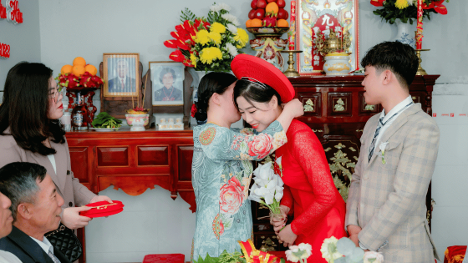
A traditional Vietnamese wedding.
FAQs About CR-1 vs. K-1 Fiancé(e) Visas For Vietnamese Couples
Here are a few other common questions that America-Vietnamese couples may have when comparing the K-1 fiancé(e) visa and CR-1 spousal visa:
Can an LPR file a K-1 fiancé(e) visa for a Vietnamese Fiancé?
No. A K-1 fiancé(e) visa is only available to fiancé(e)’s of U.S. citizens.
Do we need to meet in person before filing an I-129F Petition?
In most cases, yes. The couple must show that they met in person within the two years before filing the I-129F Petition. Limited exceptions may apply, but they are not common.
Can my Vietnamese fiancé(e) bring children on a K-1 fiancé(e) visa?
A Vietnamese fiancé(e)’s eligible unmarried children under twenty (21) may be able to apply for K-2 visas. Their eligibility depends on the facts of the case, timing, and the child’s age.
Will a prior visa denial hurt a K-1 fiancé(e) or CR-1 case?
A prior visa denial does not automatically prevent approval. However, the reason for the denial matters. Couples should disclose prior denials accurately and prepare for questions about immigration history.
Talk To a Licensed U.S. Immigration Attorney In Vietnam
As you can see, choosing between a CR-1 and K-1 fiancé(e) visa affects where you marry, when your Vietnamese partner can move, how soon they may work, how much the process may cost, and how many immigration steps remain after arrival.
Enterline and Partners helps American and Vietnam couples compare K-1 fiancé(e) visa and CR-1 spousal visa options before they file. With licensed U.S. immigration attorneys and local staff in Vietnam, our team understands both the legal process and the practical realities of preparing a case from Vietnam.
If you are deciding between a K-1 fiancé(e) visa and a CR-1 spousal visa, speak with an experienced U.S. immigration lawyer at Enterline and Partners today.
You can also review our K-1fiancé(e) visa and CR-1 visa services to learn more about each path, or schedule a consultation to discuss your options.
ENTERLINE AND PARTNERS CONSULTING
Ho Chi Minh City, Vietnam Office
Level 6 & 7, Friendship Tower, 31 Le Duan Street, Sai Gon Ward
Ho Chi Minh City, Vietnam
Tel: +84 933 301 488
Email: info@enterlinepartners.com
Facebook: Enterline & Partners – Dịch vụ Thị thực và Định cư Hoa Kỳ
YouTube: @EnterlineAndPartnersConsulting
Website: https://enterlinepartners.com
Manila, Philippines Office
LKG Tower 37th Floor
6801 Ayala Avenue
Makati City, Philippines 1226
Tel: +63 917 543 7926
Email: info@enterlinepartners.com
Facebook: Enterline and Partners Philippines
Website: https://enterlinepartners.com/en/home/
Copyright 2026. This article is for information purposes only and does not constitute legal advice. This article may be changed with or without notice. The opinions expressed in this article are those of Enterline and Partners only.