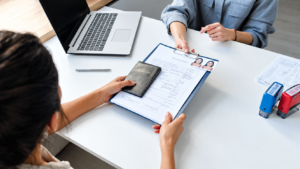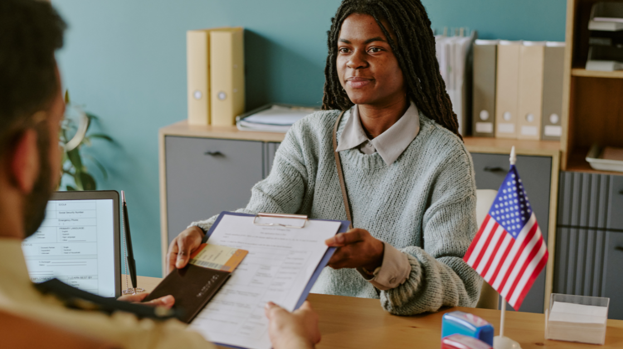
The U.S. immigrant visa interview is the final and often most important step in the immigration process, whether you’re applying through a K-1 fiancé visa, CR-1 spousal visa, or any other family-based or employment-based category. After receiving petition approval from USCIS and becoming documentarily qualified by the National Visa Center (NVC), you’ll be scheduled for your interview.
The consular interview gives you the chance to demonstrate that you’re eligible to immigrate to the United States. Arriving unprepared or without the right documents can lead to delays or even denial. This guide covers everything you need to know for your 2026 U.S. immigrant visa interview – from required documents to common questions and mistakes to avoid.
In short, thorough preparation matters, the team at Enterline and Partners can help you get ready with confidence.
U.S. Immigrant Visa Interview Process
Here is a streamlined overview of how you arrive at the interview and what to expect:
Interview Location
Your interview will take place at a U.S. Embassy or Consulate in the country where you live or the country of your nationality.
For example, if you are residing in Vietnam, you will be interviewed at U.S. Consulate in Ho Chi Minh City and not the U.S. Embassy in Hanoi. If you are a resident or are a citizen of the Philippines, you will be processed at the U.S. Embassy in Manila instead of the Consular Agency in Cebu City.
Appointment Letter and Scheduling
After you receive your interview appointment notice from the NVC, you will also be asked to pay any remaining fees such as those for the medical evaluation, complete necessary online applications such as creating a profile at US Travel Docs, and submit any missing required documents to the Consular Electronic Application Center.
Required Documents to Bring
You will need to bring the originals or certified copies (and translations for documentation that is in any language other than English), as well as the following:
- Valid passport (at least 6 months validity beyond intended U.S. entry date)
- NVC interview appointment letter
- Confirmation page of your DS-260 (online immigrant visa application) for consular processing
- All civil documents: birth certificate, marriage certificate, divorce decrees if applicable
- Police certificate (Phiếu Lý Lịch Tư Pháp for Vietnam / NBI Clearance for Philippines)
- Medical exam results from approved physician (St. Luke’s for Manila; authorized clinic for HCMC)
- Financial support documents and Affidavit of Support (Form I-864 for family-based cases) to show you will not become a public charge
- Evidence of bona fide relationship (photos, communication records, joint accounts)
- Two 2×2 inch passport-style photos
- Translations of all non-English documents (certified translators)
- Any correspondence from the NVC or instructions from the Embassy or Consulate with the checklist of required items.
Who Needs to Attend?
Typically, the principal beneficiary must attend the interview. If the principal beneficiary has any dependents (spouse or children) that has been included under the same petition, they must also attend (or appear at a subsequent interview).
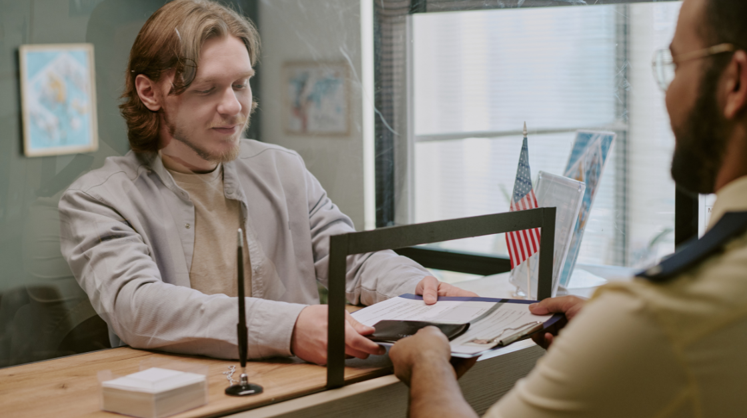
What Language Is the U.S. Visa Interview Conducted In?
While the primary language of the interview is in English, if you are more comfortable in another language such as Vietnamese, Tagalog, Chinese, etc., you may communicate in those languages as well. Some Embassies and Consulates may allow you to bring an outside interpreter provided you have received advanced approval before the scheduled interview.
Here are some tips for language preparation:
- Practice basic interview answers in English; clear, short, and to the point.
- Do not memorize long scripts. Instead, focus on key facts (your name, relationship, address, employment, reason for immigrating) and rehearse them.
- If you plan to bring an outside interpreter, make this request early, but be aware that using an interpreter may slightly lengthen the process.
When to Request Interpreter Assistance
- If your spoken English is limited and you cannot confidently respond in English.
- If key documents or relationships will be easier to explain in another language.
- If you feel you might misunderstand the officer’s questions in English, which could lead to a misunderstanding.
Common U.S. Immigrant Visa Interview Questions in 2026
While every case is unique, below are commonly asked questions in immigrant visa interviews, especially for family-based cases.
1. Questions About Personal and Family Information
- What is your full name, date of birth, and current address?
- What is your marital status, and have you ever been married before?
- Who are your children (names, ages) or dependents?
- What is your spouse’s name (if applicable), date of birth, and address?
- Where do your parents live? What are their names and ages?
2. Questions About the Petitioner (for Family-Based Cases)
- Who filed the petition for you (the Petitioner)? What is their name, immigration status, and address in the United States?
- How are you related to your Petitioner? Explain your relationship (e.g., wife/ husband, child, sibling).
- When did you last communicate with the Petitioner? In what way (phone, email, visit)?
- When do you plan to move to the U.S., and will you live with the Petitioner upon arrival?
3. Questions About Employment and Finances
- What is your current job? How long have you worked there?
- What is your income? Do you have other sources of income or assets?
- Who will support you financially when you first arrive in the United States?
- Does your petitioner in the U.S. submit a Form I-864? Can they meet the poverty guideline requirements?
- Do you have bank statements, proof of savings, or other assets?
4. Questions About Your Immigration Plans in the United States
- Which U.S. state and city do you plan to live in?
- What are your plans for work, study, or settling in the United States?
- Do you have family, friends, or acquaintances in the U.S. who will help you when you arrive?
- How soon after arrival do you intend to travel/live in the United Statest?
- Do you intend to return to your home country at any point, or will you immigrate permanently?

How to Answer U.S. Visa Interview Questions Successfully
How you respond during the interview can make a positive impression on the consular officer. Clear, confident communication shows that you understand your case and are prepared.
Take note of these tips:
- Answer honestly and clearly: The consular officer expects truthful answers. Any inconsistency with your submitted documents may raise concerns.
- Keep your responses brief and to the point: Offer the necessary information and avoid long-winded stories unless asked for clarification.
- Communicate naturally, not as though you have memorized a script: While preparation is good, overly rehearsed answers may appear robotic or insincere.
- Ensure consistency: Your verbal answers should align with what you filed in your petition (e.g., Form I-130, Petition for Alien Relative), DS-260, and all supporting documents.
- Make a positive impression: Dress neatly, bring all required documents, and behave respectfully. A calm, composed demeanor helps build confidence.
- Be ready for follow‐up questions: If the officer asks for details, respond clearly and directly.
- Avoid volunteering extra information beyond what is asked: Stick to what the question is about. If you are unsure, ask for clarification rather than guessing.
If you need more guidance, don’t hesitate to contact one of our U.S. immigration attorneys at Enterline and Partners.
What Happens After Your Immigrant Visa Interview: Approved, 221(g), or Refused
APPROVED: The consular officer will stamp your passport and return your documents in a sealed envelope. Do not open the envelope — present it to CBP at the U.S. port of entry. Your Green Card will be mailed to your U.S. address after arrival.
221(g) — ADMINISTRATIVE PROCESSING: Not a refusal. The consulate needs more time or additional documents. You may be asked to return with specific documents or wait for background check completion. This can take weeks to several months.
REFUSED — Section 214(b) or Other: The consular officer will explain the reason. For immigrant visas, the most common reasons are: insufficient evidence of relationship, incomplete financial sponsor documentation, or medical/criminal grounds of inadmissibility.
10 Common Mistakes to Avoid During Your U.S. Visa Interview
Being aware of frequent pitfalls can help you avoid jeopardizing your interview outcome. Keep these in mind:
- Missing or incorrect original documents: Not bringing originals, certified translations, or required forms causes delays or refusal.
- Answers not corresponding with submitted paperwork: Discrepancies between your interview responses and what is in your petition, DS-260, or application forms raise red flags.
- Failure to demonstrate a genuine relationship (for marriage-based or family-based cases): The officer must be satisfied that your relationship is real, ongoing, and supported by evidence.
- Lack of financial evidence or incorrect income information: If the sponsor cannot show adequate income, the petition may be placed under administrative processing. Sponsors must demonstrate income that meets the current Federal Poverty Guidelines for their household size. These thresholds are updated annually by the U.S. Department of Health and Human Services. Contact Enterline and Partners for the most current income requirements applicable to your case.
Immigration Lawyer Tips: How to Prepare for Your Visa Interview
Engaging with a qualified U.S. immigration lawyer can help you feel more confident and organized. Here are the preparation steps our attorneys recommend:
Document Organization
- Print clear copies of every document. Use folders or binders labelled by category: Identification, Relationship Evidence, Financial Support, Medical/Health, Translation Certificates, etc.
- Highlight relevant pages for quick reference during the interview.
- Prepare a “document kit”: originals + copies + translation certificates + appointment letter + medical envelope.
- Review your application forms a few days in advance so you know what you submitted and are consistent in your responses.
Mock Interview
- A U.S. immigration lawyer can conduct a mock interview to practice possible questions and help you craft clear and truthful answers.
- They can identify weak areas (e.g., relationship evidence, financial support, future plans) and help you strengthen your preparation.
- You will receive feedback on your answers, body language, and overall presentation.
Day-Of Interview Tips
- Arrive at the Embassy or Consulate well ahead of your scheduled time.
- Dress smartly: business casual or better.
- Make sure that you bring all documents and your appointment notice.
- Be polite, listen carefully to the officer’s questions, answer confidently but briefly, and maintain eye contact.
- After the interview: If approved, you will be told how and when your visa and passport will be returned. If further processing is required, ask what additional steps you should expect.
How Long Does It Take to Get a U.S. Immigrant Visa Interview in Vietnam?
Once the NVC confirms your case is documentarily complete, wait times for an interview slot depend on your consular post and several other factors.
- Visa category: Immediate relative cases (spouses, parents, children of U.S. citizens) are typically scheduled faster than family preference categories (siblings, married children)
- Visa Bulletin priority dates: Check the Department of State’s monthly Visa Bulletin to track your priority date
- Consulate workload: Interview wait times fluctuate based on overall case volume at the post
Generally, once your case is transferred from the NVC to the Consulate, you can expect an interview appointment within 2-5 months. Track your case status through the CEAC portal as instructed by the NVC.
Interview Success With Enterline & Partners
For applicants located in Ho Chi Minh City, Manila, our experienced immigration attorneys offer dedicated interview-support services.
This includes document review, mock interview session, on the ground coordination, and more, so you walk into your interview feeling organized and confident.
Frequently Asked Questions About the U.S. Immigrant Visa Interviews
What language is the U.S. visa interview conducted in?
The interview will normally be in English. If you lack confidence in English, you can request an interpreter, provided your Consulate allows that service.
Can I bring my phone to the interview?
Many U.S. Embassies and Consulates restrict electronic devices in the interview area and may not allow companions unless the applicant is a minor. Check your Embassy’s instructions carefully.
Please note that photography or recording is not allowed inside USCIS offices, except during approved naturalization or citizenship ceremonies.
Do I need a lawyer to attend the interview with me?
No, U.S. immigration lawyers do not attend the interview with you at most embassies. However, their preparation work is highly valuable in organizing your case and making sure you walk in ready.
How long after the interview will I receive my visa?
If approved, the visa is typically issued within a few days. You’ll receive your passport with the visa stamp by courier or pick-up.
If your case was placed under administrative processing, the wait may be longer. Your officer will advise you if this applies.
Where exactly is the U.S. immigrant visa interview held in Ho Chi Minh City, and how early should I arrive?
The U.S. immigrant visa interview takes place at the U.S. Consulate General in Ho Chi Minh City, located at 4 Le Duan Street, Ben Nghe Ward, District 1. Applicants should arrive at least 15-30 minutes before their scheduled appointment time to complete security screening. Note that phones, electronic devices, large bags, and beverages are not permitted inside the interview area.
What happens if my immigrant visa is denied at the interview?
If denied, you’ll receive a notice explaining the reason – commonly under Section 214(b) or other applicable grounds. Depending on the reason for denial, you may be able to refile with additional evidence or request reconsideration. Not all denials can be overcome, so it’s important to consult an experienced immigration attorney to assess your case and determine the best path forward.
I received a 221(g) notice at my interview. What should I do next?
A 221(g) notice is not a visa denial. It means the consular officer needs additional time or additional documentation before making a final decision. The notice will specify what is required: it may be a missing document, a request to schedule a follow-up appointment, or a notice that your case has been placed in administrative processing pending a background check. Read the notice carefully, respond exactly as instructed, and provide only what is asked. Do not submit additional unrequested documents unless advised to. If administrative processing is indicated without a specific document request, the wait can range from several weeks to several months. Consult an immigration attorney if you have not received a resolution after 60 days.
My spouse was approved but my child’s case is still pending. What happens?
In cases where dependents are included in the same petition, each family member goes through the process individually. If the principal applicant is approved and a dependent child’s case requires additional documentation or processing, the principal applicant may choose to proceed to the United States while the child’s case continues. Once the child is approved, they may follow to join the principal applicant. However, the principal applicant must have already entered the United States before or at the same time as any derivative beneficiary. Consult your immigration attorney before making travel decisions when a family member’s case remains open.
The consular officer asked about my social media accounts. Is this normal?
Yes. Since 2025, the U.S. Department of State requires consular officers to conduct social media screening as part of the visa adjudication process for certain visa categories including K-1 fiance visa and CR-1/IR-1 spousal visa applicants. This is now a permanent, standing requirement. The officer may ask about accounts you have listed on your DS-160, and your online presence may be reviewed as part of the background vetting process. Ensure your social media information is consistent with what you declared on your application forms.
What is the difference between a U.S. immigrant visa interview and a nonimmigrant visa interview?
An immigrant visa interview is conducted for applicants who intend to become lawful permanent residents of the United States. The consular officer evaluates eligibility for permanent immigration based on a USCIS-approved petition. A nonimmigrant visa interview is for applicants seeking temporary entry such as tourism, study or business. The two processes use different application forms, different evidentiary standards and different questions. The immigrant visa interview is generally more in-depth, covers the applicant’s relationship, finances and future plans in greater detail and results in a visa that allows the holder to enter the United States as a lawful permanent resident.
Can I bring an interpreter to my U.S. immigrant visa interview in Ho Chi Minh City or Manila?
Some U.S. consular posts allow outside interpreters with advance approval. Check the specific instructions from the U.S. Consulate General in Ho Chi Minh City or the U.S. Embassy in Manila regarding interpreter policy before your scheduled interview. If an interpreter is permitted, the request typically must be made in advance. Note that using an interpreter may add time to the interview process. The consular officer may also use a staff interpreter at the post, depending on language and availability.
What happens if my U.S. immigrant visa is approved at the interview? What do I do next?
When your immigrant visa is approved, the consular officer will stamp your passport and return your documents including a sealed envelope containing your immigrant packet. Do not open the sealed envelope under any circumstances. Present it intact to U.S. Customs and Border Protection (CBP) at your port of entry. Upon entry, CBP will process your admission as a lawful permanent resident. Your green card will be mailed to your U.S. address within a few weeks of arrival. Keep a copy of all documents and make note of your USCIS A-Number from your visa for future reference.
Contact Enterline and Partners For Experienced Guidance
If you’re looking for professional guidance to prepare for your immigrant visa interview or wish to engage our full support services, reach out to our team today.
We have office locations in Ho Chi Minh City (Vietnam), Manila (Philippines).
With decades of experience in immigration law, our attorneys help you streamline your preparation, allowing you to approach your interview composed and confident.
ENTERLINE & PARTNERS CONSULTING
Ho Chi Minh City, Vietnam Office
Level 6 & 7, Friendship Tower, 31 Le Duan Street, Sai Gon Ward, Ho Chi Minh City, Vietnam
Tel: +84 933 301 488
Email: info@enterlinepartners.com
Facebook: Enterline & Partners – Dịch vụ Thị thực và Định cư Hoa Kỳ
YouTube: @EnterlineAndPartnersConsulting
Website: https://enterlinepartners.com
Manila, Philippines Office
LKG Tower 37th Floor
6801 Ayala Avenue
Makati City, Philippines 1226
Tel: +63 917 543 7926
Email: info@enterlinepartners.com
Facebook: Enterline and Partners Philippines
Website: https://enterlinepartners.com/en/home/
Copyright 2026. This article is for information purposes only and does not constitute legal advice. This article may be changed with or without notice. The opinions expressed in this article are those of Enterline and Partners only.