Filing a family based immigrant petition for a foreign spouse is one of the most commonly applied for U.S. immigration benefits. The Form I-130, Petition for Alien Relative (“Form I-130”), filed with the United States Citizenship and Immigration Services (“USCIS”) is used by U.S. citizens and lawful permanent residents (“Green Card Holders”) to establish a qualifying relationship with their spouse.
One of the most common reasons for delays, Requests for Evidence (“RFE”), or denials is incomplete or improperly prepared supporting documentation. This guide provides clear and practical recommendations concerning Form I-130 documents helping couples understand what USCIS expects and how to prepare a strong filing.
Understanding a Form I-130 for a Foreign Spouse
The Form I-130 is not a visa application. It is a USCIS petition to prove that a valid marital relationship exists between the U.S. citizen or Green Card Holder and the foreign spouse. Once approved, the foreign spouse may apply for an immigrant visa through consular processing at a U.S. Embassy or Consulate or adjust status in the United States if eligible.
Spouses of U.S. citizens are classified as immediate relatives under U.S. immigration law, meaning they are not subject to annual visa quotas as some other family relationships. You can learn more about this classification in Enterline and Partners’ explanation of immediate relatives under U.S. immigration law.
For foreign spouses of Green Card Holders, visa availability depends on priority dates which is monitored by the visa bulletin.
Core Form I-130 Document Checklist for Spouse Petitions
When submitting a Form I-130, USCIS requires evidence to establish the U.S. citizen or Green Card Holders status, the beneficiary’s identity, and the bona fide nature of the marriage.
Below is a comprehensive Form I-130 document checklist for spouse cases.
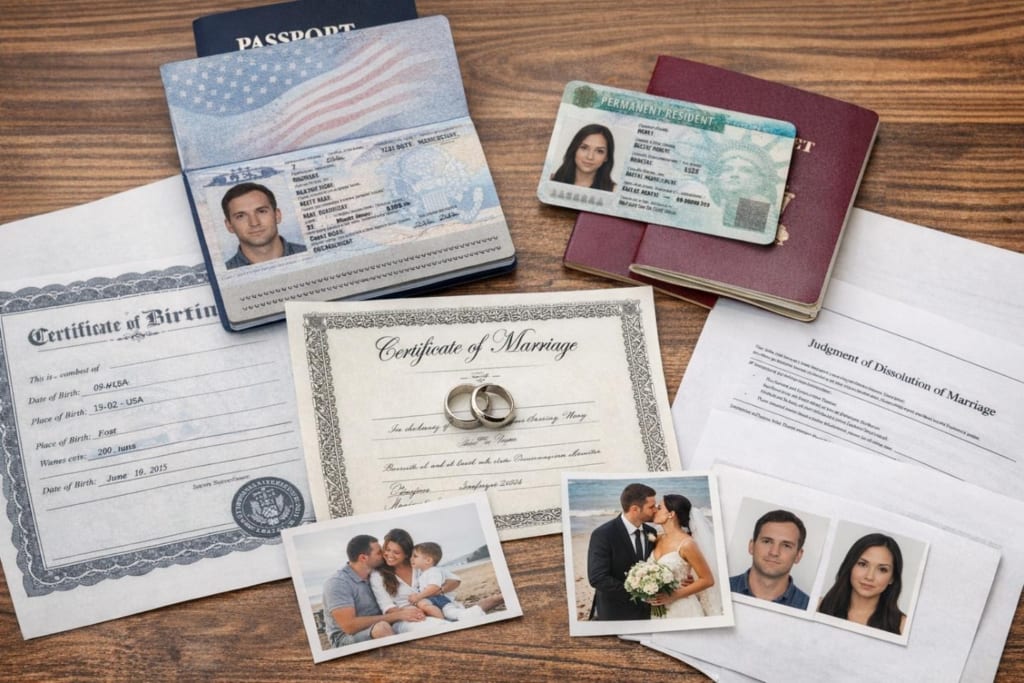
Proof of Petitioner’s U.S. Citizenship or Green Card Holder’s Status:
The petitioner must submit evidence showing they are eligible to file the Form I-130. Acceptable documents include:
- Copy of a U.S. passport biographic page;
- U.S. birth certificate;
- Certificate of Naturalization;
- For Green Card Holders, a copy of their Form I-551 (front and back) along with a copy of the foreign passport.
Only one form of proof is required, but it must be clear and legible.
Proof of Beneficiary’s Identity
The USCIS requires documentation identifying the foreign spouse, including:
- Copy of the foreign spouse’s passport biographic page;
- Copy of the foreign spouse’s birth certificate.
If the U.S. citizen, Green Card Holder or foreign spouse has ever changed their name, supporting documents showing legal name changes should also be included.
Marriage Certificate
A copy of the official marriage certificate between the U.S. citizen or Green Card Holder and the foreign spouse is mandatory. The certificate must be issued by a civil authority and show the date and place of marriage.
Religious certificates alone are generally not sufficient unless they are recognized as civil records in the country where the marriage took place.
Evidence of Termination of Prior Marriages
If either spouse was previously married, proof that all prior marriages that were legally terminated must be included.
Acceptable documents include:
- Divorce decrees;
- Annulment judgments;
- Death certificates of former spouses.
Failure to document prior marriage terminations is a common reason for USCIS issuing an RFE.
Passport Style Photographs
The USCIS requires:
- One U.S. passport size photo of the U.S. citizen or Green Card Holder;
- One U.S. passport size photo of the foreign spouse.
Photos must meet USCIS specifications and be taken within the required time frame.
Evidence of a Bona Fide Marriage
In addition to civil documents, USCIS expects evidence that the marriage is genuine and not entered into solely for immigration purposes.
Common supporting documents include:
- Family photographs taken over the course of the relationship;
- Photos from the wedding ceremony or celebrations;
- Birth certificates of children born to the couple;
- Joint financial records such as bank statements, leases, or insurance policies when available.
Quality is more important than quantity. Submitting organized, relevant evidence helps USCIS understand the relationship history clearly.
Translation Requirements for Foreign Language Documents
All documents submitted to USCIS must be in English or accompanied by a certified English translation. The translator must certify that the translation is complete and accurate and that they are competent to translate from the foreign language into English.
Improper or missing translations can lead to processing delays or additional evidence requests.
How Priority Dates Affect Some Spouse Petitions
For Foreign spouses of Green Card Holders, the Form I-130 establishes a priority date, which determines when the beneficiary may move forward with the immigrant visa or adjustment of status application.
Foreign spouses of U.S. citizens are not subject to these waiting periods, which often results in faster overall processing.
Common Mistakes to Avoid When Filing a Form I-130
Even when couples have all required documents, errors in preparation can still cause problems. Common issues include:
- Submitting incomplete or unsigned forms;
- Using outdated versions of USCIS forms;
- Failing to include proof of prior marriage termination(s);
- Providing insufficient evidence of a bona fide marriage;
- Missing certified translations.
Careful review before filing can prevent unnecessary delays.
For more information, contact us at info@enterlinepartners.com.
ENTERLINE & PARTNERS CONSULTING
Ho Chi Minh City, Vietnam Office
146C7 Nguyen Van Huong St, An Khanh Ward,
Ho Chi Minh City, Vietnam
Tel: +84 933 301 488
Email: info@enterlinepartners.com
Facebook: Enterline & Partners – Dịch vụ Thị thực và Định cư Hoa Kỳ
YouTube: @EnterlineAndPartnersConsulting
Website: https://enterlinepartners.com
Manila, Philippines Office
LKG Tower 37th Floor
6801 Ayala Avenue
Makati City, Philippines 1226
Tel: +63 917 543 7926
Email: info@enterlinepartners.com
Facebook: Enterline and Partners Philippines
Website: https://enterlinepartners.com/en/home/
Copyright 2026. This article is for information purposes only and does not constitute legal advice. This article may be changed with or without notice. The opinions expressed in this article are those of Enterline and Partners only.