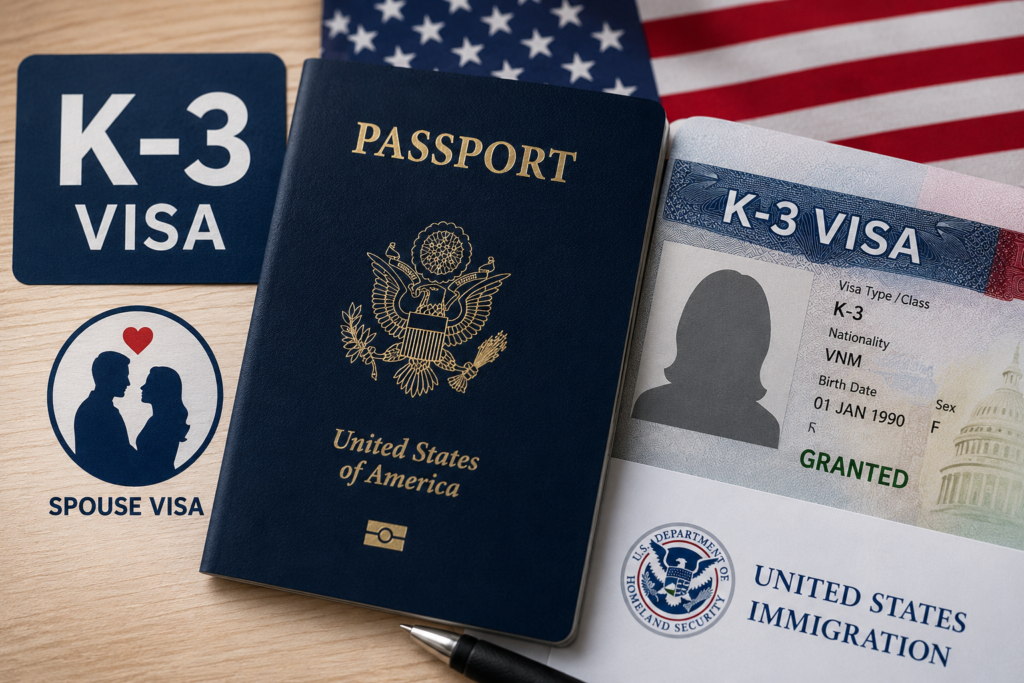
When researching U.S. family visa application options to the U.S., some couples may inquire on what the K-3 visa is and whether it is the fastest U.S. visa for family members based on marriage.
Defining the K-3 Visa
A K-3 visa is a non-immigrant visa issued to a foreign spouse married to a U.S. citizen. Like a K-1 visa, a K-3 visa is also filed using a Form I-129F Petition for Alien Fiancé(e) (“Form I-129F”). It is intended to shorten the separation period between the married couple allowing the foreign spouse to enter the United States while awaiting approval of his or her Form I-129F and subsequent immigrant visa.
Differences Between K-3 and CR-1/IR-1 Visas
Unlike a CR-1/IR-1 U.S. visa in which the foreign spouse would arrive in the United States as an immigrant and be granted lawful permanent resident status (“Green Card”) upon arrival, a K-3 visa requires the foreign spouse to first arrive in the United States and then file for Adjustment of Status (“AOS”). Once AOS is approved, the foreign spouse would be issued a Green Card giving them the same benefits as a foreign spouse who arrived in the United States as an immigrant by applying for a CR-1/IR-1 immigrant visa at an Embassy or Consulate.
What are some of the requirements for a K-3 Visa?
In order to be eligible for a K-3 visa, the foreign spouse and U.S. citizen must be legally married and first file a Form I-130 Petition for Alien Relative (“Form I-130”) with USCIS. Upon receiving a receipt notice, a Form I-129F is filed. If USCIS approves the Form I-129F before the Form I-130, the foreign spouse would then file a DS-160 Online Nonimmigrant Visa Application. Following medical clearance, the spouse and any accompanying children would undergo a visa interview at an Embassy or Consulate before being issued a K-4 visa
Is a K-3 Visa an alternative to a CR-1/ IR-1 Immigrant Visa?
While there is no harm in applying for a K-3 visa and pursuing a U.S. CR-1/ IR-1 visa at the same time, interested couples should note if the Form I-130 is approved before the Form I-129F, the Form I-129F will be terminated.
United States citizens and their foreign spouses should consider their circumstances carefully. Additionally, when preparing documentation, couples must ensure information consistency, from financial evidence to the correct name order for Vietnamese citizens, to avoid unnecessary complications.
Frequently Asked Questions
What is the K-3 visa and who is it for?
The K-3 visa is a nonimmigrant visa for the foreign national spouse of a U.S. citizen, designed to allow temporary entry to the United States while the Form I-130 immigrant petition is being processed by USCIS. After entering the U.S. on a K-3 visa, the spouse must file an Adjustment of Status (AOS) application to obtain a green card.
Is the K-3 visa better than the CR-1/IR-1 for U.S.-Vietnamese couples?
In most cases, no. The CR-1/IR-1 allows the foreign spouse to enter the United States as a conditional permanent resident immediately upon admission, with no additional application required. The K-3 requires a further AOS filing after entry, adding cost and processing time. Most immigration attorneys today do not recommend pursuing K-3 unless there are exceptional circumstances.
Can children accompany a K-3 visa applicant?
Yes. Unmarried children under 21 of a K-3 principal applicant may accompany them under the K-4 derivative category. Similar to the K-3 holder, K-4 children must also file an Adjustment of Status application after entering the United States to become lawful permanent residents.
Can a lawful permanent resident (green card holder) sponsor a spouse on a K-3 visa?
No. The K-3 visa is available only to spouses of U.S. citizens. Lawful permanent residents cannot petition for a K-3 visa. An LPR who wants to sponsor a foreign spouse must file Form I-130 under the F-2A family preference category and await a CR-1 immigrant visa.
What should we do if we are deciding between K-3 and CR-1/IR-1?
The right answer depends on the specific circumstances of each couple, including how long they have been married, the current status of any I-130 petition already on file and their plans after the spouse enters the United States. Enterline and Partners advises couples at our offices in Ho Chi Minh City and Manila to help identify the most appropriate path. Contact us at info@enterlinepartners.com to speak with a licensed U.S. immigration attorney.
For more information, contact us today at info@enterlnepartners.com and speak with a U.S. immigration attorney based in Ho Chi Minh City, Manila and Taipei.
ENTERLINE AND PARTNERS CONSULTING
Ho Chi Minh City, Vietnam Office
Level 6 & 7, Friendship Tower, 31 Le Duan Street, Sai Gon Ward
Ho Chi Minh City, Vietnam
Tel: +84 933 301 488
Email: info@enterlinepartners.com
Facebook: Enterline & Partners – Dịch vụ Thị thực và Định cư Hoa Kỳ
YouTube: @EnterlineAndPartnersConsulting
Website: https://enterlinepartners.com
Manila, Philippines Office
LKG Tower 37th Floor
6801 Ayala Avenue
Makati City, Philippines 1226
Tel: +63 917 543 7926
Email: info@enterlinepartners.com
Facebook: Enterline and Partners Philippines
Website: https://enterlinepartners.com/en/home/
Copyright 2026. This article is for information purposes only and does not constitute legal advice. This article may be changed with or without notice. The opinions expressed in this article are those of Enterline and Partners only.