Enterline & Partners Consulting | info@enterlinepartners.com

David Enterline’s Thought Leadership Comments on the Investment Immigration Industry


As part of the GMWM East Asia event, organizers requested insight from its distinguished speakers on various Thought Leadership topics. The comments below were provided by David Enterline of Enterline and Partners.

1. In one sentence, how would you describe the state of the investment immigration industry today?

The investment immigration industry has continued to expand in the last 10 years with ever more countries rolling out programs to attract the wealthy and their assets (i.e., cash) to park in-country and boost the economy (to some small degree) in exchange for residency and citizenship.

2. Chinese investors have been the predominant source of capital for the EB-5 Immigrant Investor Program. However, with an increase in minimum TEA investment threshold from $500K to $900K and $1M to $1.8M in non-TEAs, in addition to long waiting times, how will it affect the appeal of EB-5 for Chinese investors?

The EB-5 market in China has already suffered tremendously since 2018 once the market fully grasped that Chinese investors would be subject to an estimated 15 year wait for their EB-5 visas to become available and obtain their permanent residence. Primarily as a result of the long waiting time, world-wide EB-5 investor I-526 Petition filings fell from 14,373 in FY2015, 14,147 in FY2016 and 12,165 in FY2017 to 6,424 investors in FY2018, with approximately 80-85% estimated from China during those three year. A growing portion of these 2018 filings were from the second to fifth ranked countries of Vietnam, India, South Korea and Taiwan as well as modest increases of investors from around the rest of the world. Therefore, the long waiting time has already impacted the China market. Other economic and political forces, as well as the growing number of alternative attractive residence and citizenship programs will likely continue to have bearing on continued low interest from Chinese for the EB-5 program, more so than the increase to the minimum investment of $900,000.

3. How do you see the industry evolving over the next 5 years?

I believe we will continue to see expansion in the investment immigration business as the number of programs increase and become more competitive and as high net worth individuals continue to seek second and even third country resident status and citizenship.


For more information, please contact us at

ENTERLINE & PARTNERS CONSULTING
Ad: 3F, IBC building, 1A Cong Truong Me Linh Str, District 1, HCMC.
Tel: 0933 301 488
CATEGORY
time
recent posts
CTA_Collection

contact us today for more information

Latest News

NVC

What is the NVC and What Happens After USCIS Approval? (2026 Guide)

Having an immigrant petition approved by the United States Citizenship and Immigration Services (“USCIS”) is an important milestone, but for many applicants living outside the United States, it is not the end of the immigration process. Following USCIS approval, the case moves to the National Visa Center (“NVC”) which is under the Department of State (“DOS”). The NVC processing involves creating a case number, paying visa application fees, collecting and submitting documentation and waiting for the case to be transferred to a U.S. Embassy or Consulate. At Enterline and Partners, our U.S. immigration attorneys represent clients in Asia through the different stages of the immigration process, including family-based immigration cases, K-1 fiancé(e) visa cases, and EB-5 immigrant investor cases. In this guide, we will walk you through what happens after USCIS approval, what to expect from NVC processing and how to prepare for the consular processing stage of your case.

Read more >
Phỏng Vấn Visa Mỹ

What Happens After Your U.S. Visa Interview in Ho Chi Minh City?

Completing your immigrant or K-1 fiancé(e) visa interview at the U.S. Consulate General in Ho Chi Minh City is an important step in the immigration process. However, you may still need to complete additional steps before you can travel to the United States. Some visa applicants leave the interview knowing that the consular officer intends to approve their visa while others receive instructions to submit more documents or learn that their case requires additional review. Understanding what happens after your U.S. visa interview can help you follow the correct instructions, avoid unnecessary delays and prepare for your arrival. If you have questions about what happens next in your case, contact Enterline and Partners for guidance today. What Does “Approved” Mean After a U.S. Visa Interview? If the consular officer tells you that your visa is approved, this generally means the officer has found you eligible based on the information available

Read more >

Business Plans for Regional Center Investments

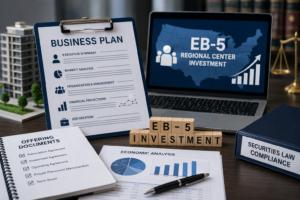
Before an EB-5 immigrant investor files a Form I-526E Petition for classification based on an investment in a Regional Center sponsors investment, the Regional Center must first file an application with the Secretary of Homeland Security (Form I-956F) for each particular investment offering in an associated New Commercial Enterprise (“NCE”). The Form I-956F application must provide comprehensive information regarding the proposed investment, its projected job creation, offering documents, potential risks, and compliance with applicable securities laws. Business Plan and Economic Analysis The Form I-956F application must include a comprehensive business plan for a specific capital investment project. In addition, the Regional Center must provide a credible economic analysis regarding estimated job creation, based on methodologies that are economically and statistically valid and transparent. The Form I-956F application must also include any documents that are required by law to be filed with the Securities and Exchange Commission (“SEC”) under the Securities

Read more >
Zalo
Phone
WhatsApp
Messenger
Messenger
WhatsApp
Phone
Zalo