Family-based immigration is an important aspect of the United States immigration system, which allows citizens and lawful permanent residents to sponsor their immediate relatives to immigrate to the United States. One of the family-based immigrant visa categories is the Family-Based Second Preference immigrant visa category, commonly abbreviated as F2A and F2B categories.
The F2A category is for spouses and unmarried children under the age of 21 of lawful permanent residents. The F2B category is for unmarried children over the age of 21 (sons and daughters) of lawful permanent residents. Both categories are subject to annual numerical limitations set by the U.S. Congress. When the demand for visas in a category exceeds the annual limit, a waiting list is established while priority date on the visa bulletin becomes current when a visa number is available.
The waiting time for a second preference immigrant visa can vary greatly depending on several factors, including the beneficiary’s country of origin, the demand for a specific visa category, and the number of applicants already waiting for a visa in that visa category. To determine the wait time for a first preference visa, the U.S. Department of State (“DOS”) publishes a monthly Visa Bulletin, which lists the priority date “cut-off” for each family-based and employment-based preference category. The priority date is the date that the lawful permanent resident files the I-130 Petition for Alien Relative on behalf of the beneficiary with the United States Citizenship and Immigration Services (“USCIS.”).
The Visa Bulletin lists the priority date for each preference category, which is the date on which the U.S. Citizenship and Immigration Services (“USCIS”) received the I-130 Petition for Alien Relative (“I-130 Petition”) filed on behalf of the beneficiary. The priority date determines the beneficiary’s place in line for an immigrant visa—such immigrant visas are made available to individuals in the order in which their priority dates become current.
The estimated wait time is determined by the difference between the current priority date and the cut-off date listed on the Visa Bulletin. If the beneficiary’s priority date is before the cut-off date, they may be able to apply for an immigrant visa or adjust their status to a legal permanent resident.
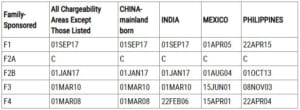
In the above Visa Bulletin, based on the priority date under All Chargeability Areas on Table A Final Action Date in the Visa Bulletin of March 2023, the F2A category is Current “C”, so visas are immediately available, and the F2B category shows a priority date of September 22, 2015. If a lawful permanent resident files an I-130 Petition for an unmarried son or daughter today it could take approximately 8 years for a visa to become available. The wait time will be considerably longer for nationals of Mexico and the Philippines.
It is very important to understand that these priority dates may not move forward for many months; they might move forward only 1 week a month; they might jump forward by weeks or even months, or they might even move backward (retrogress), depending on demand. Therefore, the priority date is only useful for a general idea of how long an applicant might wait for a visa to become available.
This estimate is based on the current demand for immigrant visas in this category and the availability of such immigrant visas in the U.S. immigration system. It may seem that from the priority date being about 8 years difference that this would be the wait time, but it is important to keep in mind that the wait time can vary depending on several factors, including the number of visas that are made available each year, and the number of individuals who are waiting in line. The priority date does not move forward on a regular schedule.
If you have questions about U.S. visas, contact us at info@enterlinepartners.com and speak with a U.S. immigration attorney in Taipei, Ho Chi Minh City, and Manila.
ENTERLINE & PARTNERS CONSULTING
Ho Chi Minh City, Vietnam Office
Suite 601, 6th Floor, Saigon Tower
29 Le Duan Street
Ben Nghe Ward, District 1
Ho Chi Minh City, Vietnam
Tel: +84 933 301 488
Email: info@enterlinepartners.com
Facebook: Enterline & Partners – Dịch vụ Thị thực và Định cư Hoa Kỳ
YouTube: @EnterlineAndPartnersConsulting
Website: http://enterlinepartners.com
Manila, Philippines Office
Tel: +63 917 543 7926
Email: info@enterlinepartners.com
Facebook: Enterline and Partners Philippines
Website: https://enterlinepartners.com/language/en/welcome/
Copyright 2023. This article is for information purposes only and does not constitute legal advice. This article may be changed with or without notice. The opinions expressed in this article are those of Enterline and Partners only.