Enterline & Partners Consulting | info@enterlinepartners.com

USCIS Publishes Two New Forms for the EB-5 Regional Center Program

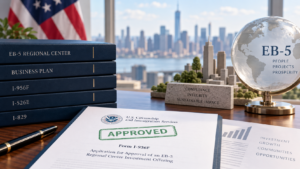
As anticipated, the United States Citizenship and Immigration Services (“USCIS”) has just released two new forms for use in the EB-5 Regional Center Program following the enactment of the EB-5 Reform and Integrity Act of 2022 (“Act”); the Form I-956, Application for Regional Center Designation, and I-956H, Bona Fides of Persons Involved with Regional Center Program.

Under the Act, all entities seeking regional center designation must submit Form I-956 to be in compliance with the new Regional Center Program requirements.

Any person that will be involved with a regional center, new commercial enterprise (“NCE”) or affiliated job-creating entity (“JCE”) must file Form I-956H.

Guidance for who must file Form I-956H is provided in the form itself and also in the Form I-956H instructions which are also available at the above link.

A person is “involved” with a regional center, NCE or affiliated JCE if the person is, directly or indirectly, in a position of substantive authority to make operational or managerial decisions over pooling, securitization, investment, release, acceptance or control or use of any funding.

A person may be in a position of “substantive authority” if they serve as a principal, a representative, an administrator, an owner, an officer, a board member, a manager, an executive, a general partner, a fiduciary, an agent or in a similar position at the regional center, NCE, or JCE, respectively. A person involved with a JCE that is not an affiliated JCE may, at the Secretary of the Department of Homeland Security’s discretion, also be required to complete Form I-956H.

Each person must complete a Form I-956H for each entity with which they are involved for submission with any related form, as applicable. The person must have a United States address to file the Form I-956H.

There is no filing fee for Form I-956H.  However, a biometric services fee of $85 is required for each person who submits a Form I-956H.  Interestingly, the Form I-956H and the biometrics fee must be submitted at the time of filing Form I-956.  This indicates that any entity filing Form I-956, Application for Regional Center Designation must collect all involved person’s Form I-956H and a check or credit card filing fee for the biometrics services fee before filing the Form I-956 and there does not appear any instruction if a regional center, NCE or JCE needs to file additional Forms I-956H to add involved person at a later time.

If you have questions about the new EB-5 rules under the Act, contact us at info@enterlinepartners.com and speak with a U.S. immigration attorney in Ho Chi Minh City, Manila and Taipei.

ENTERLINE & PARTNERS CONSULTING

Ho Chi Minh City, Vietnam Office

Suite 601, 6th Floor, Saigon Tower
29 Le Duan Street
Ben Nghe Ward, District 1
Ho Chi Minh City, Vietnam

Tel: +84 933 301 488

Email: info@enterlinepartners.com

Facebook: Enterline & Partners – Dịch vụ Thị thực và Định cư Hoa Kỳ

Website: http://enterlinepartners.com

Manila, Philippines Office

LKG Tower 37th Floor
6801 Ayala Avenue
Makati City, Philippines 1226

Tel: +632 5310 1491

Email: info@enterlinepartners.com

Facebook: Enterline and Partners Philippines

Website: https://enterlinepartners.com/language/en/welcome/

Copyright 2022. This article is for information purposes only and does not constitute legal advice. This article may be changed with or without notice. The opinions expressed in this article are those of Enterline and Partners only.


CATEGORY
time
recent posts
CTA_Collection

contact us today for more information

Latest News

Step-by-Step Guide to the K-1 Fiance(é) Visa Process

Applying for a K-1 fiancé(e) visa involves multiple government agencies, including United States Citizenship and Immigration Services (“USCIS”), the National Visa Center (“NVC”), and the appropriate U.S. Embassy or Consulate. As a result, the process requires careful coordination at each stage. If you are researching how to apply for a K-1 visa, it’s important to understand that even minor mistakes can result in Requests for Evidence (“RFE”) or interview delays. Although processing times in 2026 have stabilized compared to pandemic backlogs, review standards remain strict. This guide will walk you through the full K-1 visa process, including eligibility requirements, filing steps, costs, timelines, and when legal representation may help reduce risk. Couples who prefer structured oversight may choose to work with Enterline and Partners, an American-owned immigration and investment consulting firm based in Ho Chi Minh City, Vietnam and Manila, Philippines, for assistance with petition strategy, documentation review, and consular

Read more >

F4 Visa Bulletin Update: Waiting Time for Family-Based Sibling Immigration

The U.S. immigration system provides a specific pathway for U.S. citizens to sponsor their siblings for lawful permanent residency (“Green Card.”) The Family-Based Fourth Preference (F4) category is dedicated to the brothers and sisters of adult U.S. citizens ages twenty-one (21) and above. While this is a popular route for family reunification, the F4 category visa waiting time is historically the longest in the system due to annual caps and high global demand. How the Wait Time is Shown on the U.S. Visa Bulletin The wait time for an immigrant visa in the F4 category is determined by the United States Department of State’s Visa Bulletin. The Visa Bulletin lists the priority date for each preference category, which is the date on which the United States Citizenship and Immigration Services (“USCIS”) received the Form I-130 Petition for Alien Relative (“Form I-130”) filed by the U.S. Citizen petitioner on behalf of

Read more >

The U.S. EB-5 Immigrant Investor Regional Center Program: History, Temporary Status, and Expiration Timeline

The EB-5 Reform and Integrity Act of 2022 (“RIA”) reauthorized and reformed the EB-5 Immigrant Investor Program, a U.S. immigration program that offers foreign nationals a pathway to U.S. permanent residency through investment in American businesses that create jobs. A significant component of this program is the EB-5 Immigrant Investor Regional Center Program, which allows investors to consolidate their resources through designated Regional Centers and invest in projects that drive economic growth and job creation. The Regional Center Program was introduced by Congress in 1992 as a pilot program to enhance the EB-5 visa classification. It was classified as a pilot program – a short-term “test” program – to allow for more flexibility for job creation based on the minimum investment.  Investments may be made into businesses or “projects” sponsored by Regional Centers, which are approved by the United States Citizenship Immigration Services.  Typically, these Regional Centers manage or oversee

Read more >
Zalo
Phone
WhatsApp
Messenger
Messenger
WhatsApp
Phone
Zalo