Enterline & Partners Consulting | info@enterlinepartners.com

What Do You Need to Get a Visa for the USA?

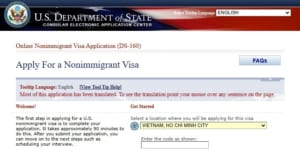
In order to be issued a U.S. visa, you must apply directly through either the U.S. Embassy in Hanoi or the U.S. Consulate in Ho Chi Minh City. All applicants are required to fill out a DS 160 online application and pay the visa processing fee. The fee depends on the type of visa you are applying for which ranges from US$160 (VND3,840,000) to US$265 (VND4,920,000). The fee can be paid over the counter at any Vietnam Post branch. All visa processing fees are non-refundable once paid.

After you have paid your visa processing fee and completed the DS 160 online application, you may schedule an appointment. Scheduling an appointment can be done either over the phone or online.

On the day of your scheduled interview, it is recommended that you arrive between 20-30 minutes early. In addition to the DS 160 online application confirmation page and your passport, you are welcome to bring supplemental documentation such as tax returns, bank statements, proof of home ownership, employment certificates, and any additional information that could be used to demonstrate that you fully intend on returning to Vietnam following your temporary trip to the United States. While supplemental documentation is not required, the interviewing consular officer may request to see the documentation.

Always remember to smile at the consular officer and answer the questions truthfully. If approved, your visa will be issued and sent via courier to your designated address.

For more information, contact us at:

ENTERLINE & PARTNERS CONSULTING
Ad: 3F, IBC building, 1A Cong Truong Me Linh Str, District 1, HCMC.
Tel: 0933 301 488
CATEGORY
time
recent posts
CTA_Collection

contact us today for more information

Latest News

Understanding Form I-864A: Contract Between Household Member and Sponsor

For many family-based immigrants applying for a Green Card, a key step in the process is the submission of Form I-864, Affidavit of Support (“I-864”). This is a legally binding contract in which the sponsoring family member (“Sponsor”) agrees to financially support the intending immigrant (“Beneficiary”). However, in some cases, the “Sponsor” alone may not have sufficient income or assets to meet the required financial support threshold. That is where Form I-864A, Contract Between Sponsor and Household Member (“Form I-864A”) comes into play. A Form I-864A,  is used when a household member—such as a spouse, adult child, parent, or other relative residing at the same address—agrees to combine their income with the Sponsors to meet the minimum financial requirement. The household member must be willing to commit to support the Beneficiary alongside the Sponsor by signing the Form I-864A. It is important to understand the difference between the I-864 and

Read more >

Are K-1 Fiancé(e) Visas Affected by Trump’s 2025 Immigration Policies?

With the return of the Trump administration in 2025, many couples are asking the critical question: “Are K-1 Fiancé(e) visas (hereinafter “fianc(é)”)   affected by Trump’s new immigration policies?” While there is currently no outright ban on K-1 fianc(é) visas, applicants should be prepared for significant changes in processing, increased scrutiny, and potential delays. Following the precedents set during Trump’s previous term and recent executive orders in early 2025, the landscape for family-based immigration, including the K-1 visa, is shifting. Understanding these changes is vital for a successful application. Current Status of K-1 Visas in 2025 As of now, the K-1 fianc(é) visa program remains active. It has not been suspended. However, the administration’s focus on heightened security and “extreme vetting” is already impacting how these visas are processed. Unlike immigrant visas, K-1 visas are technically classified as nonimmigrant visas by the Department of State, even though they are treated

Read more >

Infrastructure Project, Rural Area, And Targeted Employment Area In The RIA

In the EB-5 Reform and Integrity Act of 2022 (“RIA”), three important terms are Infrastructure Project, Rural Area, and Targeted Employment Area (“TEA”). Here’s a clear explanation of each: Infrastructure Project An infrastructure project refers to a capital investment project administered by a governmental entity, such as a federal, state, or local agency. It typically involves a job-creating entity that works with a new commercial enterprise to receive capital investments from EB-5 investors. These projects are characteristically for improving public infrastructure with the added benefit of creating jobs and helping to stimulate local economic growth. Rural Area According to EB-5 regulation, areas that are within the geographic boundaries of a metropolitan statistical area are not eligible for the rural area designation, ensuring that the rural area classification is applied to regions that outside metropolitan zones and truly rural. A Rural Area excludes areas within the boundaries of cities or towns

Read more >
Zalo
Phone
WhatsApp
Messenger
Messenger
WhatsApp
Phone
Zalo