A B-1 domestic employee visa permits certain foreign domestic workers to temporarily accompany their employer to the United States to manage household or other domestic services.
The visa is narrowly defined and carefully regulated. It applies only when there is an established employment relationship and when the employer’s stay in the United States is temporary.
Unfortunately, this visa is often misunderstood. While it falls under the broader B-1 visitor visa classification, it does not permit general employment in the United States. Instead, it authorizes a specific, limited form of domestic employment that exists exclusively to support the employer during a temporary stay.
Understanding how this visa category works, who qualifies, and what documentation is required is essential.
What is the Purpose of the Visa B-1 Domestic Employee Visa?
The B-1 domestic employee visa exists to allow domestic employees to travel temporarily with their employers to the United States without disrupting long-established household arrangements.
It is designed for situations where the employer relies on a trusted domestic employee and replacing that employee during a temporary stay in the United States would be impractical or create hardship for the family.
Domestic employment services permitted under this visa typically include:
- Live-in nannies and childcare providers;
- Live-in elder caregivers or personal attendants;
- Housekeepers and household managers;
- Cooks or personal chefs;
- Drivers or chauffeurs.
All services must be performed exclusively for the employer’s private household. Any work for another individual, family, or business is strictly prohibited.
Who Can Qualify as an Employer?
Not every employer is eligible to bring a domestic employee under a B-1 visa. Consular officers adjudicating a domestic employee applying for a B-1 visa apply a strict criteria in determining that the employer’s stay is temporary and that the visa is not used to bypass U.S. labor or immigration laws.
In general, an eligible employer must be either:
- A U.S. citizen who normally resides outside the United States and is visiting the U.S. temporarily, or;
- A non-immigrant visa holder (such as a B, E, L, H, or other qualifying status) who is temporarily present in the United States.
In both scenarios, the employer must demonstrate strong ties outside the United States and show a clear intent to return abroad. Lawful permanent residents (“Green Card Holders”) are ineligible to qualify as employers.
Evidence of Residence Abroad
Consular officers at Embassies and Consulates typically expect documentary proof showing that the employer’s life remains centered outside the United States. This may include:
- Property ownership or long-term lease agreements abroad;
- Ongoing employment or business operations outside the United States;
- Family ties and dependents residing overseas;
- Financial records (including offshore tax filings) showing continued foreign residence;
- For U.S. citizen employers, dual nationality or permanent residence in another country (i.e. Hong Kong Permanent Indemnity Card Holders, Singapore Permanent Resident, etc).
Without strong evidence of ties abroad, an application may be refused.
If you’re not sure whether your situation meets these requirements, consulting with an experienced U.S. immigration lawyer from Enterline and Partners can help you assess eligibility, identify documentation gaps, and avoid issues before filing or attending a visa interview.

An au pair arrives at an American airport.
Eligibility Requirements for the Domestic Employee
The domestic employee must independently qualify for the visa. Approval depends not only on the employer’s status; the following factors are also considered:
Prior Employment Relationship
In most cases, the domestic employee must have worked for the employer for at least one year. This requirement demonstrates that the relationship is genuine and not created solely for immigration purposes.
Non-Immigrant Intent
The domestic employee must demonstrate non-immigrant intent by demonstrating sufficient ties abroad that they do not intend to abandon. Consular officers carefully assess whether the applicant plans to return home after the authorized stay.
Common evidence includes:
- Property or lease agreements in the home country;
- Family ties abroad;
- Prior U.S. travel history showing compliance with visa terms;
- Employment or financial obligations outside the United States.
Failure to establish nonimmigrant intent is a common reason for visa refusal.
Exclusive Employment Requirement
A B-1 domestic employee may work only for the sponsoring employer. Any additional work, even informal or unpaid assistance to others, violates visa conditions and can lead to serious immigration consequences.
Employment Contract and Legal Protections
United States immigration authorities place significant emphasis on the employment terms and conditions. The goal is to protect domestic workers from exploitation and ensure compliance with U.S. labor standards.
A written employment contract is mandatory and must be signed by both parties. The contract typically includes:
- Guaranteed wages that meet or exceed U.S. federal, state, or local minimum wage requirements;
- A detailed description of job duties and working hours;
- Confirmation that the employer will cover all house and travel expenses including travel to and from the employee’s home country;
- A statement affirming that the employee will not be required to live on the employer’s premises after working hours;
- Assurance that the employee retains possession of their passport and personal documents.
Contracts that appear vague, one-sided, or inconsistent with United States labor regulations may lead to a visa refusal.
Duration of Stay and Visa Limitations
The B-1 domestic employee visa is strictly temporary. The authorized period of stay may match the duration of the employer’s temporary presence in the United States.
In some cases, extensions of stay may be requested by filing a Form I-539, Application to Extend/ Change Nonimmigrant Status with the United States Citizenship and Immigration Services (“USCIS”), but approval is not automatic. The USCIS evaluates whether the employer’s stay remains temporary and whether all visa conditions continue to be met.
Overstaying or violating visa conditions can jeopardize the domestic employee’s future U.S. visa eligibility.
Inspection at the U.S. Port-of-Entry
A B-1 domestic employee visa does not guarantee entry. Upon arrival, B-1 domestic employees are subject to inspection by United States Customs and Border Protection (“CBP”).
The CBP Officer may ask questions about:
- The nature of the employment relationship;
- Length of prior employment;
- Intended duration of stay;
- Living and working arrangements in the United States.
Inconsistencies between the visa application, employment contract, and verbal statements can result in being refused entry even with a valid visa.
Preparation and consistency are critical at this stage. Working with a U.S. immigration lawyer before travel can help ensure that documentation is complete, statements are aligned, and potential issues are addressed in advance.
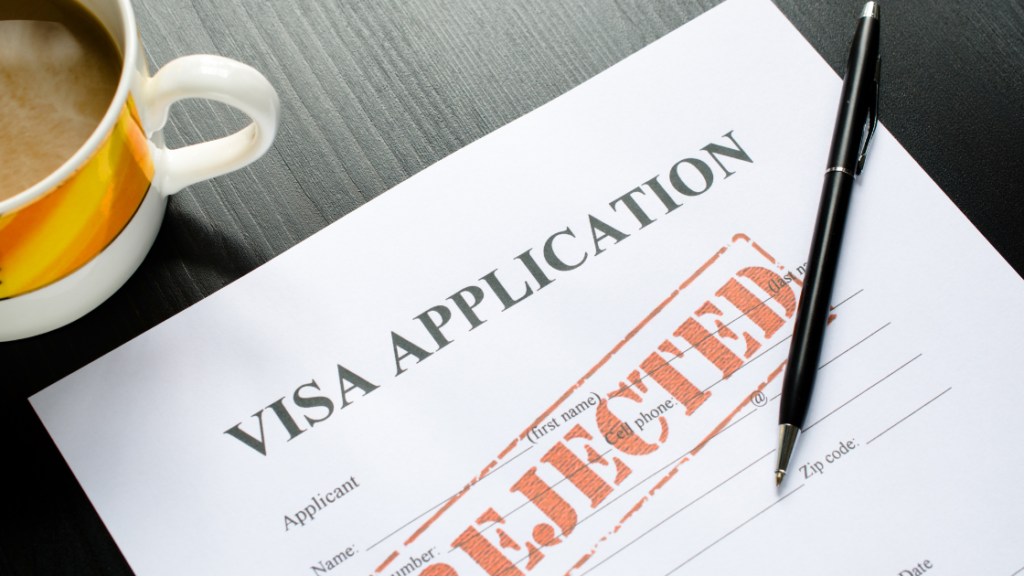
A denied visa.
Common Reasons for Visa Refusal
B-1 domestic employee visa applications may be refused due to avoidable issues, including:
- Insufficient proof of prior employment;
- Weak evidence of non-immigrant intent;
- Employment contracts that fail to meet U.S. labor standards;
- Employer’s inability to prove residence abroad;
- Signs that the employment relationship was created solely for visa purposes.
Because officers apply strict scrutiny, professional guidance can make a significant difference.
Why Legal Guidance Is Important
Even experienced employers and domestic workers can encounter problems if documentation is incomplete or poorly prepared. Still, early legal review can help ensure compliance, reduce risk, and improve the likelihood of approval.
At Enterline and Partners, our expert U.S. immigration attorneys assist clients with:
- Evaluating employer and employee eligibility;
- Preparing compliant employment contracts;
- Assembling strong supporting evidence;
- Handling consular interviews and port-of-entry inspections.
Professional guidance helps prevent delays, refusals, and costly mistakes.
Frequently Asked Questions
What is the B-1 visa for domestic workers and how does it differ from a standard B-1 visa?
A standard B-1 visa is for foreign nationals visiting the United States for temporary business activities such as meetings, contract negotiations or conferences. The B-1 for domestic workers is a separate, specialized subcategory that allows personal employees such as nannies, housekeepers, cooks, chauffeurs and caregivers to accompany or follow a qualifying employer to the United States temporarily. While both use the B-1 designation, they have entirely different eligibility requirements and conditions.
Can a domestic worker on a B-1 visa begin working immediately after entering the United States?
No. Despite holding a valid B-1 visa and being lawfully admitted to the United States, a domestic worker must file Form I-765 with USCIS and receive an Employment Authorization Document (EAD) before beginning work or receiving wages from a U.S. source. With current USCIS processing times for EADs ranging from 3 to 9 months, careful advance planning and concurrent extension filings are essential. Working without an EAD is a violation of immigration status.
What prior employment relationship is required?
For domestic workers employed by a U.S. citizen employer: the worker must have worked for the sponsoring employer for at least 6 months to 1 year abroad, or must have at least 1 year of prior domestic worker experience confirmed by statements from previous employers. For domestic workers employed by nonimmigrant visa holders: the worker must have been employed by the same employer abroad for at least 1 year before the employer’s U.S. admission, or the employer must demonstrate that they have regularly employed domestic workers in the same capacity.
What must the employment contract include?
The signed employment contract must include: a specific job title and description of duties; weekly work hours; compensation at no less than the applicable minimum or prevailing wage, whichever is higher; paid vacation and sick leave; a commitment to provide free room and board; employer payment of travel costs from the worker’s home country to the U.S. and return upon termination; and a clause confirming the worker will be employed exclusively by the sponsoring employer and will not seek other employment.
Can the B-1 domestic worker visa be extended and for how long?
Yes. Extensions are available in increments of 6 months to 1 year, provided the employer remains in the United States temporarily and has not exceeded the 6-year total limit, the employment relationship continues, and the EAD is renewed concurrently. It is strongly recommended to file both the B-1 extension and the EAD renewal at the same time to avoid gaps in work authorization. If the employer departs the United States, the domestic worker is generally expected to depart as well.
Learn How Enterline & Partners Can Help
If you are considering applying for a B-1 domestic employee visa or have questions about eligibility and compliance, early consultation is strongly recommended.
ENTERLINE AND PARTNERS CONSULTING
Ho Chi Minh City, Vietnam Office
Level 6 & 7, Friendship Tower, 31 Le Duan Street, Sai Gon Ward
Ho Chi Minh City, Vietnam
Tel: +84 933 301 488
Email: info@enterlinepartners.com
Facebook: Enterline & Partners – Dịch vụ Thị thực và Định cư Hoa Kỳ
YouTube: @EnterlineAndPartnersConsulting
Website: https://enterlinepartners.com
Manila, Philippines Office
LKG Tower 37th Floor
6801 Ayala Avenue
Makati City, Philippines 1226
Tel: +63 917 543 7926
Email: info@enterlinepartners.com
Facebook: Enterline and Partners Philippines
Website: https://enterlinepartners.com/en/home/
Copyright 2026. This article is for information purposes only and does not constitute legal advice. This article may be changed with or without notice. The opinions expressed in this article are those of Enterline and Partners only.