Marriage to a U.S. Citizen does not automatically grant a Vietnamese spouse the right to live permanently in the United States. Before a Vietnamese spouse can immigrate to the United States, the U.S. Citizen or Lawful Permanent Resident (“Petitioner”) must first establish the marital relationship, complete the required documentation and have the process go through the U.S. immigration system.
Multiple government agencies are involved including United States Citizenship and Immigration Services (“USCIS”), the United States Department of State (“DOS”), National Visa Center (“NVC”) and the U.S. Consulate General in Ho Chi Minh City. Each stage has separate forms, evidence requirements and deadlines.
At Enterline and Partners, our U.S. immigration lawyers assist Petitioners with a spouse in Vietnam who would like to bring their Vietnamese spouses to the United States permanently. In this guide, we explain the sponsorship process, the difference between filing as a U.S. Citizen or a Lawful Permanent Resident, the role of Form I-864, Affidavit of Support (“Form I-864”) and common problems that can delay a case.
Who Can Sponsor a Vietnamese Spouse?
You may file a Form I-130, Petition for Alien Relative (“Form I-130”) for your Vietnamese husband or wife if you are:
- A U.S. Citizen
- A Lawful Permanent Resident (“Green Card Holder”)
The marriage must be legally valid in the place where it occurred. Couples who are married in Vietnam will need an official Vietnamese marriage certificate that meets the document requirements for immigrant visa processing.
Both spouses must also have been legally free to marry when the marriage took place. If either person was previously married, additional evidence must be provided such as a divorce decree, annulment order or death certificate.
U.S. Citizen Petitioner vs. Green Card Holder Petitioner
While U.S. Citizens and Green Card Holders are eligible to petition their Vietnamese spouse, the immigration categories are different:
U.S. Citizen Petitioner
A Vietnamese spouse of a U.S. Citizen is an immediate relative and not subject to annual immigrant visa limits, so the case is not subjected to a prolonged waiting period for an immigrant visa.
The visa classification generally depends on how long the couple has been married when the Vietnamese spouse is either issued an immigrant visa or arrives in the United States as an immigrant:
- CR-1 visa: Used when the marriage is less than two years old.
- IR-1 visa: Used when the marriage is at least two years old.
A spouse who enters the United States with a CR-1 visa receives conditional permanent residence for two years. The couple will need to file Form I-751, Petition to Remove Conditions on Residence, before that conditional resident period expires.
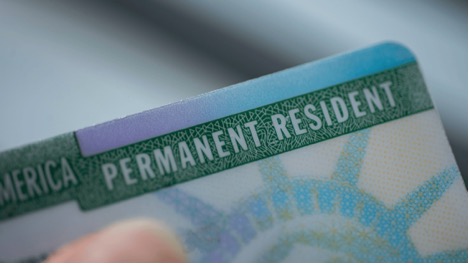
An IR-1 Vietnamese spouse receives a 10-year Form I-551 (“Green Card”) and does not need to complete the removal-of-conditions process.
Green Card Holder Petitioner
A Vietnamese spouse of a Green Card Holder falls within the F2A family-preference category. Unlike the immediate-relative category, F2A cases depend on immigrant visa availability.
The Green Card Holder may still begin the process by filing Form I-130. However, the case may be subjected to long delays until the priority date is current before the NVC can complete processing and schedule the visa interview.
If the Green Card Holder becomes a U.S. Citizen while the case is pending, the case may be upgraded from the F2A category to the immediate-relative category.
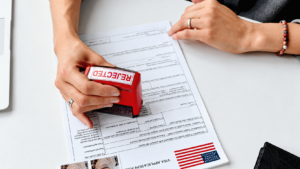
A Green Card application form.
The Petition Process: Step-by-Step
Most Form I-130 cases involving a Vietnamese spouse living in Vietnam consist of the following steps:
Step 1: File Form I-130 With USCIS
The first stage is filing the Form I-130 in which the Petitioner is requesting for USCIS to recognize the qualifying marital relationship. The documentation normally includes:
- Form I-130;
- Form I-130A, Supplemental Information for Spouse Beneficiary;
- Proof of the Petitioner’s Identification such as a U.S. Passport or a Copy of the Green Card;
- Marriage Certificate;
- Documents Terminating Any Previous Marriages;
- Passport-Style Photographs, When Required;
- Evidence of a Bonafide Marriage; and
- Filing Fee.
Forms should use names, dates and places consistently. Vietnamese names may appear in different orders or spellings after translation or transliteration. So, any variation should be reviewed and explained before filing rather than left for USCIS or the consular officer to interpret.
Step 2: Wait for USCIS to Review the Form I-130
The USCIS may approve, deny, or issue a Request for Evidence if the filing does not contain enough information.
Keep in mind that approval of Form I-130 does not mean that the Vietnamese spouse will be guaranteed to immigrate to the United States. An approved Form I-130 confirms that USCIS has accepted that the marital relationship is bona fide and allows the case to proceed to the NVC for immigrant visa processing.
Note: Processing times vary according to the Petitioner’s status, the USCIS Service Center adjudicating the Form I-130 and the complexity of the case. Couples should be cautious about relying on a single estimated timeline because USCIS workloads can change.
Step 3: Begin National Visa Center Processing
Following USCIS approval, the file is transferred to the NVC which assigns a case number and provides instructions for using the Consular Electronic Application Center (“CEAC”). At this stage, the following steps are required:
- Pay the DS-260 online immigrant visa application fee;
- Pay the Form I-864 fee;
- Complete Form DS-260, Immigrant Visa and Alien Registration Application;
- Submit the Form I-864 and financial evidence;
- Upload the required civil documents;
- Provide any additional documents requested for the case.
The Petitioner along with the Vietnamese spouse should carefully review the DS-260 prior to submission. Information about previous U.S. travel, visa refusals, overstays, employment, addresses and family members should remain consistent.
Step 4: Submit Vietnamese Civil Documents
The Vietnamese spouse will need to submit the following documents through CEAC:
- A valid passport;
- Birth certificate;
- Marriage certificate;
- Police certificates showing no criminal record;
- Divorce or death records from previous marriages;
- Court or prison records, if applicable;
- Military records, when required; and
- Certified translations of documents not in English.
Step 5: Complete the Medical Examination and Interview
After the NVC reviews and approves the documents, the case is documentarily qualified. Once an interview appointment becomes available, the Vietnamese spouse will receive instructions for the immigrant visa interview at the U.S. Consulate General in Ho Chi Minh City.
Before the interview, the applicant must complete the following:
- Register the required delivery information;
- Complete a medical examination with an approved panel physician;
- Gather original civil documents;
- Prepare updated relationship evidence; and
- Review the DS-260 for accuracy.
At the interview, the consular officer may ask how the couple met, how the relationship developed, how they communicate, when they decided to marry and what they plan to do after moving to the United States.
The purpose is to assess the credibility of the relationship and the accuracy of the immigration record.
Step 6: Enter the United States
If approved, the Vietnamese spouse will receive an immigrant visa placed in the passport. The spouse must enter the United States before the visa expires, usually in about six months
The USCIS immigrant fee should also be paid so USCIS can produce and mail the physical Green Card. Upon admission to the United States with the immigrant visa, the spouse is officially a Green Card Holder even while waiting for the physical Green Card to arrive in the mail.
Petitioner’s Financial Requirements
The Petitioner must submit a Form I-864, Affidavit of Support. This form is a legally enforceable commitment to provide financial support to the Vietnamese spouse when needed.
In most cases, the sponsor must show household income equal to at least 125% of the applicable Federal Poverty Guidelines. The required amount depends on household size and is updated periodically.
Household size may include:
- The sponsor;
- The immigrating spouse;
- Dependent children;
- Other dependents listed on the sponsor’s tax return;
- Certain previously sponsored immigrants, and;
- Other immigrants included in the current sponsorship case.
The Petitioner commonly submits IRS tax transcripts, proof of current employment and recent evidence of income.
What If the Petitioner’s Declared Income Is Too Low?
Depending on the case, the Petitioner may be able to use:
- Qualifying assets which must equal at least three times the income shortfall.
- Income from an eligible household member through Form I-864A;
- A qualified joint sponsor of who must independently meet the income requirements.
- A combination of permitted income and assets.
The Petitioner Must Establish U.S. Domicile
The Petitioner must have a U.S. domicile, which means the United States is his or her main permanent home.
If the Petitioner currently lives abroad, he or she may need to show that he or she is restablishing domicile; making the United States the primary home again, no later than the Vietnamese spouse’s admission.
This requirement can be especially important if the Petitioner has been living and working in Vietnam for several years. Evidence may include applying for jobs in the United States, arranging housing, maintaining or opening U.S. bank accounts, transferring funds, registering to vote, filing U.S. tax returns and taking other practical steps to prepare for the move.

Spouses reunited in the United States.
How Much Does it Cost to Petition a Vietnamese Spouse?
The total cost may include:
- The Form I-130 filing fee;
- NVC Affidavit of Support and immigrant visa fees;
- Medical examination and vaccination costs;
- Vietnamese civil document fees;
- Translation expenses;
- Travel to Ho Chi Minh City;
- The USCIS immigrant fee;
- Legal fees, if an attorney is retained; and
- Form I-751, Petition to Remove Conditions if the Vietnamese spouse receives conditional residence.
Government fees can change, so couples should confirm current amounts before filing or making a payment.
Common Problems When Petitioning a Vietnamese Spouse
A case may be delayed, questioned or denied for several reasons. Some of the common ones we encounter include:
Insufficient Proof of a Bona fide Marriage
Limited evidence is especially when the couple has spent little time together, married soon after meeting or has difficulty explaining how the relationship developed.
Useful evidence may include:
- Living together;
- Travel records;
- Photographs taken throughout the relationship;
- Messages or call records;
- Proof of financial support;
- Shared plans; and
- Evidence of contact with each other’s families.
The strongest evidence depends on how the couple actually lives. Submitting hundreds of screenshots without context may be less useful than a smaller, organized record showing the course of the relationship.
Inconsistent Information
Differences involving names, addresses, employment dates, travel history or prior relationships can affect your credibility.
Previous Visa Refusals or Immigration Violations
A previous nonimmigrant visa refusal such as a B-1/B-2 Visitor Visa (i.e. tourist visa) does not automatically prevent approval of an immigrant visa. However, the Vietnamese spouse must disclose all prior visa refusals.
An overstay, removal order, false statements made to a U.S. government officer or attempted misuse of an earlier issued visa may raise more serious legal issues. The effect depends on what happened, how long ago it occurred and what appears in the immigration record.
Missing or Incorrect Civil Documents
Uploading an unofficial copy, incomplete translation or document from an incorrect authority may delay NVC review. The applicant must also bring the required originals to the interview.
Financial Sponsorship Problems
Incorrect household-size calculations, missing tax evidence, insufficient proof of current income and unresolved domicile questions are frequent sources of delay.
Possible Inadmissibility
Certain criminal records, prior fraud, health-related grounds and immigration violations may make an applicant inadmissible. Some grounds allow a waiver of inadmissibility, but eligibility is highly fact-specific.
Document Checklist for Sponsoring a Vietnamese Spouse
The Petitioner must prepare:
- Completed Form I-130 and Form I-130A – names, dates, and places must be consistent throughout
- U.S. Passport or Green Card copy as proof of status
- Original marriage certificate with certified English translation
- Divorce decrees or death certificates from all previous marriages
- Form I-864 Affidavit of Support with IRS tax transcripts (3 most recent years)
- Current employment letter and recent pay stubs
- Evidence of bona fide marriage: photographs, travel records, messages, financial support
The Vietnamese spouse must prepare:
- Valid passport (minimum 6 months validity beyond intended entry date)
- Birth certificate with certified English translation
- Police clearance certificate
- Completed Form DS-260 – reviewed carefully for accuracy before submission
- Medical examination results from an approved panel physician in Ho Chi Minh City
- Original civil documents to bring to the interview
- Updated relationship evidence prepared for the consular interview
FAQs About Petitioning a Vietnamese Spouse
You may still have questions about timing, financial sponsorship, interviews and what happens while the case is pending. The answers below cover some of the issues sponsors most often need to understand:
How long does it take to petition a Vietnamese spouse from beginning to end?
The timeline depends on USCIS processing, NVC document review and interview availability in Ho Chi Minh City. If the Petitioner Green Card Holder, the F2A priority date may also affect how long your spouse must wait.
Your case may take longer if USCIS requests more evidence, the NVC rejects a document or the consular officer requires additional review.
Can I petition my spouse if I live in Vietnam?
Yes. You may still file Form I-130 while living in Vietnam. However, you will need to show that you have maintained a permanent home in the United States or plan to re-establish one before your spouse enters the country before the immigrant visa interview at the U.S. Consulate in Ho Chi Minh City.
Can my Vietnamese spouse visit the United States while the I-130 is pending?
A pending I-130 does not automatically cancel a valid visitor visa or prevent your spouse from applying for one. However, your spouse must still show that the visit is temporary and is not intending to immigrate at that time.
Can a friend be a joint sponsor?
Yes, a friend may qualify as a joint sponsor. The person does not need to be related to you or your spouse, but must independently meet the citizenship or permanent residence, age, U.S. domicile and income requirements.
What is the difference between the CR-1 and IR-1 visa for a Vietnamese spouse?
Both the CR-1 and IR-1 are immigrant visas for spouses of U.S. Citizens, but they differ based on how long the couple has been married. The CR-1 (Conditional Resident) visa applies when the marriage is less than two years old at the time the visa is issued – the Vietnamese spouse enters as a conditional permanent resident and must file Form I-751 before the two-year period expires to remove the conditions. The IR-1 (Immediate Relative) visa applies when the marriage is at least two years old – the Vietnamese spouse enters as a permanent resident with a 10-year Green Card and does not need to complete the removal-of-conditions process.
What is the difference between sponsoring a spouse as a U.S. Citizen vs. a Green Card holder?
U.S. Citizens sponsor their Vietnamese spouse as an Immediate Relative – there is no annual visa cap and no waiting period for visa availability. Green Card holders sponsor their Vietnamese spouse under the F2A family preference category, which is subject to annual visa limits and Visa Bulletin priority dates. This means Green Card holder cases can face significantly longer waits – sometimes 2-3 years or more. If the Green Card holder naturalizes as a U.S. Citizen while the case is pending, the case can be upgraded to the Immediate Relative category, which eliminates the waiting period.
What happens at the immigrant visa interview at the U.S. Consulate in Ho Chi Minh City?
The consular officer evaluates whether the marriage is genuine and whether the Vietnamese spouse is eligible for an immigrant visa. Questions typically cover how the couple met, how the relationship developed, how they communicate day-to-day, when they decided to marry, and what their plans are after moving to the United States. The Vietnamese spouse must bring original civil documents, updated relationship evidence, and be prepared to answer questions consistently with the information submitted throughout the petition. If approved, the immigrant visa is placed in the passport and the spouse must enter the United States before the visa expires – typically within approximately six months.
Start Your Case With Enterline and Partners
Petitioning your spouse affects more than one application. Each form becomes part of a permanent immigration record, and an error made during the first stage may reappear during NVC processing or the consular interview.
Enterline and Partners assists U.S. Citizens and Green Card Holder Petitioners to bring their Vietnamese spouses to the United States.
With U.S. immigration lawyers experienced representing Vietnamese, our firm can review the relationship history, prepare the petition, address financial sponsorship questions and help your Vietnamese spouse prepare for the interview in Ho Chi Minh City.
Contact Enterline and Partners today to discuss your case.
ENTERLINE & PARTNERS CONSULTING
Ho Chi Minh City, Vietnam Office
Level 6 & 7, Friendship Tower, 31 Le Duan Street, Sai Gon Ward
Ho Chi Minh City, Vietnam
Tel: +84 933 301 488
Email: info@enterlinepartners.com
Facebook: Enterline & Partners – Dịch vụ Thị thực và Định cư Hoa Kỳ
YouTube: @EnterlineAndPartnersConsulting
Website: https://enterlinepartners.com
Manila, Philippines Office
LKG Tower 37th Floor
6801 Ayala Avenue
Makati City, Philippines 1226
Tel: +63 917 543 7926
Email: info@enterlinepartners.com
Facebook: Enterline and Partners Philippines
Website: https://enterlinepartners.com/en/home/
Copyright 2026. This article is for information purposes only and does not constitute legal advice. This article may be changed with or without notice. The opinions expressed in this article are those of Enterline and Partners only.