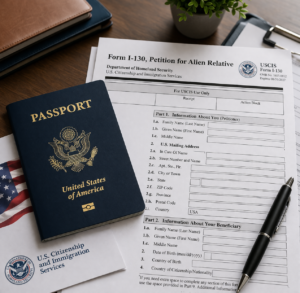
Applying for a K-1 fiancé(e) visa involves multiple government agencies, including United States Citizenship and Immigration Services (“USCIS”), the National Visa Center (“NVC”), and the appropriate U.S. Embassy or Consulate. As a result, the process requires careful coordination at each stage.
If you are researching how to apply for a K-1 visa, it’s important to understand that even minor mistakes can result in Requests for Evidence (“RFE”) or interview delays. Although processing times in 2026 have stabilized compared to pandemic backlogs, review standards remain strict.
This guide will walk you through the full K-1 visa process, including eligibility requirements, filing steps, costs, timelines, and when legal representation may help reduce risk.
Couples who prefer structured oversight may choose to work with Enterline and Partners, an American-owned immigration and investment consulting firm based in Ho Chi Minh City, Vietnam and Manila, Philippines, for assistance with petition strategy, documentation review, and consular preparation.
What Is the K-1 Fiance(é) Visa?
The K-1 fiance(é) visa allows a foreign national engaged to a U.S. citizen to enter the United States for the purpose of marriage.
After entering the U.S., the couple must marry within ninety (90) days. The foreign spouse can then apply for lawful permanent residence (“Green Card”) through Adjustment of Status.
Only U.S. citizens can petition a foreign national for a K-1 visa.
Eligibility Checklist (Do You Qualify?)
Before filing, confirm that you meet all K-1 visa eligibility requirements:
- The petitioner must be a U.S. citizen. Green Card holders are ineligible to file a K-1 visa.
- The relationship must be bona fide. The U.S. citizen and foreign national must prove that their relationship is genuine and bonafide.
- Meeting in person within the last two years. The U.S. citizen and foreign national must present evidence that they have physically met in person. If they have not met in person, a waiver may be possible if it can be demonstrated that meeting in person would result in extreme hardship or violate long-established cultural or religious practices.
- Both parties must be legally free to marry. Any prior marriages must have been terminated either through divorce, annulment, or death.
The 4-Step K-1 Visa Application Process
Successfully applying for a K-1 visa always begins with understanding the correct order of the process:
Step 1: Filing a Form I-129F, Petition for Alien Relative
The process begins when the U.S. citizen files the Form I-129F, Petition for Alien Fiancé(e) (“Form I-129F”) with USCIS.
Key documents include the following
- Proof of U.S. citizenship (passport, naturalization certificate or birth certificate);
- Evidence of having met in person within two years;
- Travel records (boarding passes, passport stamps, etc);
- Signed letters of intent to marry within 90 days;
- Relationship Photos.
Step 2: NVC Processing and DS-160
After USCIS approval, the case is sent to the NVC. The NVC assigns a case number and forwards the petition to the appropriate U.S. Embassy or Consulate.
The foreign fiancé must then complete the DS-160, online nonimmigrant visa application and the following:
- Pay the MRV Visa Fee;
- Schedule the interview and the U.S. Embassy or Consulate through U.S. Travel Docs;
- Begin preparing required civil and financial documentation.
At this stage, organization is essential. Missing civil documents can delay interview scheduling. It might help to consult a U.S. immigration attorney during this process.

Step 3: The Medical Exam and Interview
Before the interview, the K-1 visa foreign national must complete a medical exam with an authorized panel physician.
Meanwhile, the Embassy or Consulate interview is the most critical stage. A consular officer evaluates:
- Whether the relationship is genuine;
- Whether the couple intends to marry within ninety (90) days upon the foreign nationals arrival in the United States;
- Whether the U.S. citizen is able to financially support the foreign national;
- Whether any security, health, criminal or other issues exist.
Expect detailed questions about:
- How you met;
- Important dates in your relationship;
- Wedding plans;
- Family awareness of the engagement.
If approved, the foreign national receives the K-1 fiance visa in their passport.
If an additional review is required, the case will enter administrative processing.
Step 4: Entry and Marriage
After the K-1 visa issuance, the foreign national travels to the United States.
The couple must marry within ninety (90) days of entry.
Failure to marry within 90 days will result in the following:
- Loss of legal status;
- Ineligibility to adjust status through that petition;
- Possible removal proceedings.
After marriage, the foreign national spouse files for an Adjustment of Status to obtain a Green Card.
How to Apply for a K-1 Visa with an Immigration Attorney
Many couples ask whether they should complete the process on their own or hire an attorney?
Why Use A U.S. Immigration Attorney?
While you can file on your own, an experienced immigration attorney can help with the following:
- Organizes the timeline;
- Prepares required and supplemental documentation in complex cases;
- Addresses red flags (e.g., large age gaps, prior visa denials, short courtships);
- Responds to RFEs;
- Prepares you for the Embassy or Consulate interview.
Keep in mind that an attorney cannot speed up processing, but they can reduce the risk of costly delays.
Do It Yourself (“DIY”) vs. Immigration Attorney Support
| Issue | DIY Filing | With an Immigration Attorney |
| Form accuracy | You prepare alone | Reviewed by an attorney |
| Red flags | You must address them | Legal strategy drafted |
| RFE response | You research yourself | Attorney drafts response |
| Interview prep | Self-prepared | Guided interview preparation |
| Risk of delays | Higher if mistakes | Lower with review |
If your case involves a criminal history, U.S. immigration violations, complicated histories, and other ineligibility issues, legal guidance is strongly recommended.
To discuss your situation and reduce the risk of delays or denial, contact our attorneys for experienced guidance on your K-1 visa strategy.

K-1 Visa Cost and Timeline (2026 Estimates)
Before filing, you need a clear picture of the full financial commitment involved in the K-1 process, from initial petition fees to post-marriage adjustment costs.
Government Fees (2026 Estimates)
- Form I-129F filing fee: US$675
- MRV Fee: US$265
- Medical exam cost (varies by country)
- Vietnam
- Adults (15 years and older): US$334 – US$389 (approx. VND 8,800,000 – VND 10,300,000)
- Children (ages 2–14): US$284 (approx. VND 7,500,000) Children under 2 years: US$210 (approx. VND 5,500,000)
- Philippines
- Adults (15 years and older): PHP 28,650
- Children (under 15 years): PHP 13,910
- Taiwan
- All applicants: NTD 8,000 – NTD 13,000
- Vietnam
- Adjustment of Status filing fee after marriage: US$1,440
Processing Time (2026 Average)
As of 2026, the total K-1 visa process averages 12-14 months which includes USCIS processing, the NVC and the interview at the U.S. Embassy or Consulate.
FAQs on K-1 Visa Applications
Below are concise answers to some of the most common questions couples ask our team during the K-1 visa process.
Can I work on a K-1 visa?
K-1 visa holders may apply for work authorization while concurrently filing for Adjustment of Status.
What happens if we don’t marry in 90 days?
If the marriage does not occur within 90 days, the foreign fiancé loses legal status and must leave the U.S. The visa cannot be extended.
Does hiring a lawyer guarantee approval?
No. No attorney can guarantee approval. However, an experienced attorney may reduce errors, strengthen documentation, and improve preparation.
Plan Your K-1 Visa Strategy With a Licensed U.S. Immigration Attorney
Learning how to apply for a K-1 visa requires patience and careful attention to detail. While the process is manageable, it leaves little room for error. Missing documents, inconsistent information, or weak supporting evidence can delay approval and complicate later stages such as adjustment of status.
Some couples with straightforward circumstances choose to file on their own. But when a case involves prior immigration issues, criminal history, financial concerns, or other complexities, reviewing the petition with an experienced immigration attorney before filing can help prevent avoidable problems.
If you’re preparing a K-1 fiance(e) visa and would prefer experienced guidance before filing, you can speak with Enterline and Partners to review your case and plan the next steps with clarity.
ENTERLINE AND PARTNERS CONSULTING
Ho Chi Minh City, Vietnam Office
Level 6 & 7, Friendship Tower, 31 Le Duan Street, Sai Gon Ward
Ho Chi Minh City, Vietnam
Tel: +84 933 301 488
Email: info@enterlinepartners.com
Facebook: Enterline & Partners – Dịch vụ Thị thực và Định cư Hoa Kỳ
YouTube: @EnterlineAndPartnersConsulting
Website: https://enterlinepartners.com
Manila, Philippines Office
LKG Tower 37th Floor
6801 Ayala Avenue
Makati City, Philippines 1226
Tel: +63 917 543 7926
Email: info@enterlinepartners.com
Facebook: Enterline and Partners Philippines
Website: https://enterlinepartners.com/en/home/
Copyright 2026. This article is for information purposes only and does not constitute legal advice. This article may be changed with or without notice. The opinions expressed in this article are those of Enterline and Partners only.